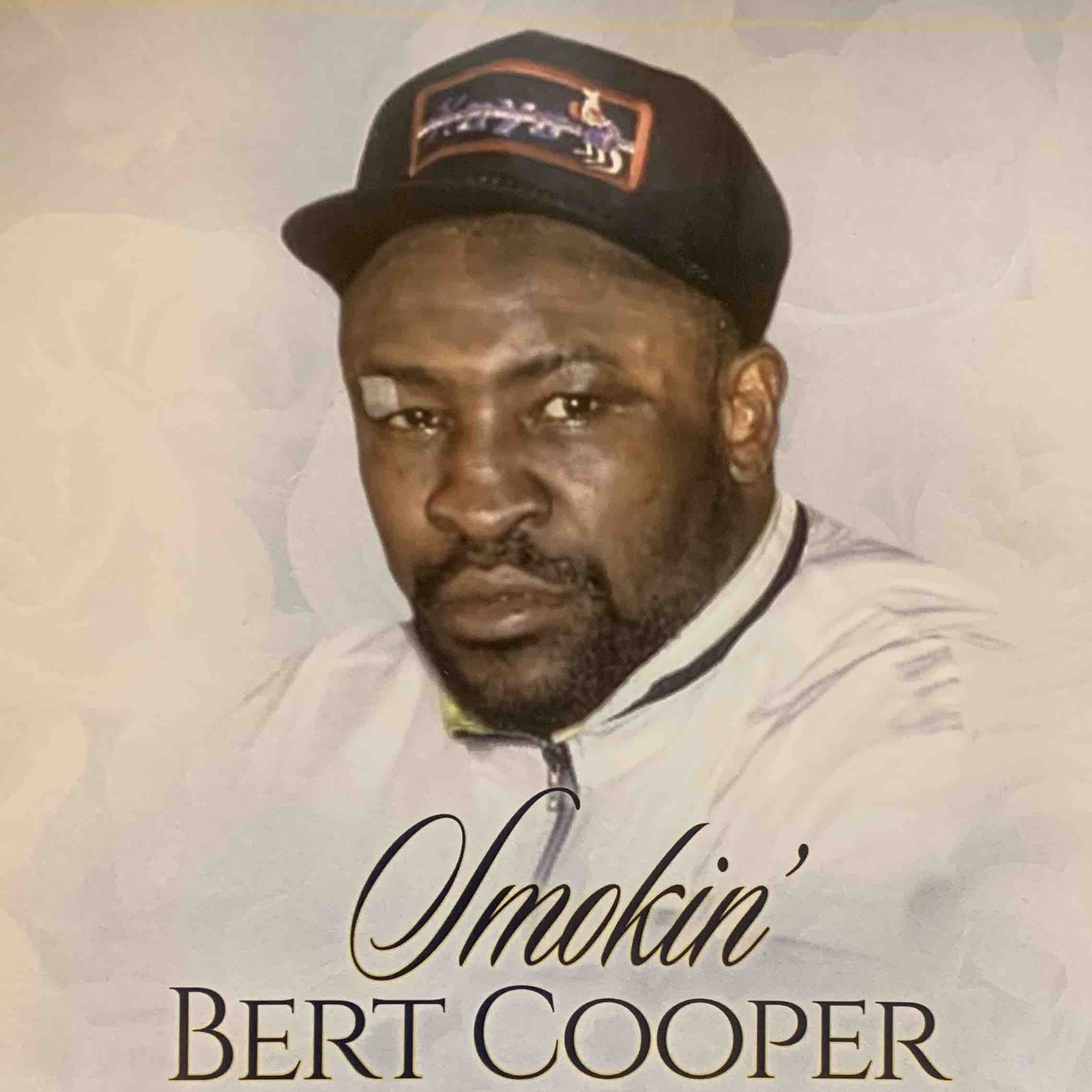
Bert Cooper
Legendary Contender
Bert Cooper brought the threat of a knockout into fights that appeared to be beyond his reach. The compact Philadelphia-area puncher won regional championships at cruiserweight and heavyweight, then came close to taking world titles from Evander Holyfield and Michael Moorer. His career was uneven, but his best performances were more than brief flashes of power: they showed a dangerous inside fighter who could force elite opponents into exchanges they had hoped to avoid.
Bert Cooper pictured in a cap and jacket. The “Smokin’” nickname connected him with his early trainer, Joe Frazier.
Sharon Hill beginnings and Joe Frazier’s gym
Born in Sharon Hill, Pennsylvania, on January 10, 1966, Cooper developed as a boxer in the Philadelphia gym tradition. Joe Frazier trained him early in his career, and Cooper adopted both the “Smokin’” nickname and an attacking approach associated with the former heavyweight champion.
Cooper turned professional in 1984. He preferred to close the distance, work the body and bring hooks and uppercuts into play. His right hand was particularly dangerous when an opponent stood within range. He could change a fight with a short punch rather than a long, conspicuous wind-up.
The comparison with Frazier was useful but incomplete. Cooper had his own strengths and limitations, and his results depended on more than whether he could imitate his mentor. Stamina, preparation and the ability to get past a taller opponent’s jab were recurring tests.
A cruiserweight championship and the Willie de Wit upset
Cooper earned the NABF cruiserweight title by outpointing Henry Tillman over twelve rounds in Atlantic City on June 15, 1986. Tillman had won Olympic heavyweight gold in 1984, making the victory an important step beyond Cooper’s early knockout wins. The belt was a regional championship, not a world title.
On February 14, 1987, Cooper travelled to Regina, Saskatchewan, and stopped unbeaten Canadian heavyweight Willie de Wit in the second round. De Wit was an Olympic silver medallist with considerable expectations behind him. Cooper’s ability to drive through a larger man’s defences made the result one of his most convincing early performances.
His progress was not uninterrupted. Carl Williams stopped him later in 1987, and Nate Miller eventually took his cruiserweight championship. Cooper’s wins had established his power; the defeats showed how difficult it could be for him to sustain an attack when the other man controlled distance or survived the first exchanges.
Cooper’s 1987 win over Willie de Wit in Regina.
Heavyweight success against Norris and a hard night with Mercer
The move to heavyweight placed Cooper against men with greater size and strength. George Foreman defeated him in 1989 after Cooper did not come out for the third round. It was a setback, but his heavyweight opportunities continued.
On February 17, 1990, he took the NABF heavyweight title from Orlin Norris in Edmonton. Norris was behind on points when a knee injury left him unable to continue in the eighth round. Cooper had now held regional titles in two divisions, an achievement that helped keep him relevant in a crowded heavyweight field.
Ray Mercer won a twelve-round unanimous decision over Cooper on August 5, 1990, taking that belt. The scores were clear, yet the exchanges were punishing. Mercer later recalled Cooper as both a demanding sparring partner and a particularly tough opponent. Their bout was a regional title contest; Mercer’s WBO world championship came later.
A second-round loss to Riddick Bowe followed in October 1990. Cooper then rebuilt his opportunity with four consecutive stoppage victories, including a fifth-round win over Joe Hipp in October 1991.
The night he nearly overturned Holyfield’s championship
Cooper met Evander Holyfield at Atlanta’s Omni on November 23, 1991, after two planned opponents withdrew. Mike Tyson’s injury had ended the original match, and Francesco Damiani was also forced out. Cooper became the late replacement.
Holyfield was the undisputed heavyweight champion, but the sanctioning distinction matters: his WBA and IBF belts were at stake against Cooper, while the WBC refused to sanction the bout.
Cooper was knocked down by a body shot in the first round. In the third, his right hand hurt Holyfield, and a follow-up attack drove the champion into the ropes. Referee Mills Lane ruled a knockdown because the ropes had kept Holyfield upright. It was the first official knockdown of Holyfield’s professional career.
For a brief period, the championship was genuinely in danger. Holyfield recovered, regained control and stopped Cooper late in the seventh round. Cooper had lost, but the fight demonstrated that his power remained a serious threat against the best heavyweight in the world.
Bert Cooper challenging Evander Holyfield in 1991.
Archival fight clip shared by Boxing Only
Archival clip of Cooper’s 1991 challenge to Evander Holyfield.
Trading knockdowns with Michael Moorer
A second major championship opportunity arrived against Michael Moorer for the vacant WBO heavyweight title in Atlantic City on May 15, 1992. The southpaw’s cleaner technique did not prevent Cooper from making the contest dangerous almost immediately.
Both men were down in the opening round. Cooper dropped Moorer again in the third, keeping the outcome uncertain even as the punishment accumulated. Moorer eventually put Cooper down in the fifth and won by stoppage.
The two title fights reveal the same central feature of Cooper’s boxing: he could threaten a superior all-round fighter if he brought the contest into close, forceful exchanges. They also show the difference between hurting a champion and finishing the job. Holyfield and Moorer recovered and found a way to win.
Later victories, losses and a long career
Cooper continued against established heavyweights and emerging contenders. His opponents included Mike Weaver, Corrie Sanders, Chris Byrd and, much later, Luis Ortiz. The later losses added substantially to his record, but he remained capable of upsetting an opponent who underestimated the danger.
In July 1997, he knocked out previously unbeaten Richie Melito in the first round at the Madison Square Garden Theater. That win brought him the WBF heavyweight belt. It was a title from a smaller organisation and did not make him the generally recognised world heavyweight champion.
After a lengthy absence, Cooper returned to boxing in 2010 and competed until 2012. His career totals were 38 wins and 25 losses, with 31 knockout victories and one no-contest. The record spans his promising early run, two major world-title challenges and many years as an experienced opponent.
A puncher remembered for more than his defeats
Cooper’s strongest work combined short-range punching, determination and a willingness to exchange under pressure. He was not consistently successful enough to dominate his division, but his wins over Tillman, de Wit and Norris gave his career substance beyond the famous near-upset of Holyfield.
He died on May 10, 2019, aged 53, after suffering from pancreatic cancer. His place in heavyweight history rests on the nights when his punches disrupted the expected order: an overlooked challenger could suddenly make a championship seem within reach.
Career highlights illustrating Cooper’s close-range punching power.

