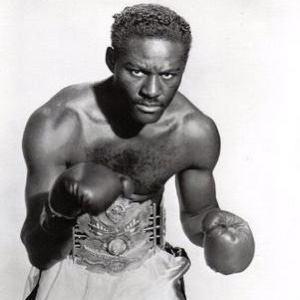
Ezzard Charles was a heavyweight champion whose accomplishments began well below the heavyweight limit. The “Cincinnati Cobra” defeated outstanding middleweights and light heavyweights before succeeding Joe Louis as champion. His four championship meetings with Jersey Joe Walcott and two challenges against Rocky Marciano form a major part of the division’s postwar history, but they are only one part of an exceptional body of work.
Charles brought speed, combination punching and defensive awareness to opponents with different sizes and styles. He could win through precise boxing or finish decisively when an opening appeared. His heavyweight achievements should be considered alongside his earlier victories, rather than reducing him to the man who followed Louis or lost to Marciano.
Ezzard Charles in a boxing pose, wearing gloves and white trunks.
The Cincinnati Cobra’s development
Ezzard Mack Charles was born in Lawrenceville, Georgia, on July 7, 1921, and grew up in Cincinnati. He established himself in amateur boxing before turning professional in 1940. His career developed through the middleweight and light-heavyweight divisions, where the opposition required considerably more than athletic promise.
He defeated Charley Burley twice and eventually recorded three victories over Archie Moore, four over Jimmy Bivins and five over Joey Maxim. Those results demonstrate the breadth of his technical accomplishment: his standing was built against fighters who were themselves among the most accomplished of their time.
Service in the United States Army interrupted his professional career in 1944 and 1945. After returning, he again beat leading opposition. Despite his outstanding light-heavyweight record, Charles never held that division’s world championship. His reputation at the weight rests on whom he defeated and how consistently he competed against elite fighters.
Retained highlights of Charles’s combinations, movement and defensive skill.
Walcott in 1949: winning the NBA heavyweight title
Louis’s retirement created the opening for Charles to fight Walcott at Comiskey Park in Chicago on June 22, 1949. Charles won a unanimous decision over fifteen rounds and claimed the vacant National Boxing Association heavyweight championship. The NBA was the organization that later became the WBA.
The victory did not immediately bring universal recognition. New York and several other authorities did not initially accept the new champion. That distinction is essential to the chronology: Charles had won a genuine world-title contest, but the post-Louis championship picture had not yet settled around a single accepted successor.
Walcott was already an experienced championship challenger, rather than an opponent selected simply to create an easy coronation. Beating him required Charles to deal with changes of rhythm, feints and counterpunching over a long fight. The result began a rivalry that would produce four world-title meetings and two victories for each man.
Defeating Joe Louis and consolidating recognition
Louis returned to challenge Charles at Yankee Stadium on September 27, 1950. Charles won a unanimous decision over fifteen rounds, with all three official scorecards clearly in his favor. The returning former champion was substantially heavier, but Charles’s speed and consistent scoring prevented Louis from imposing the attack that had defined his earlier reign.
The result confirmed Charles as Louis’s competitive successor. Louis was returning after more than two years without a professional contest and was no longer the fighter of his peak seasons. Even with that qualification, Charles had faced the challenge directly and won convincingly rather than relying solely on a title left vacant by retirement.
New York and The Ring recognized Charles after this victory. British recognition remained with Lee Savold until Louis defeated Savold in June 1951, after which that remaining distinction ended. Describing Charles as universally recognized immediately after the Louis fight overlooks this final part of the process.
An active champion and a second win over Walcott
Charles made eight successful defenses of the NBA title between winning it in 1949 and losing it in 1951. His reign included victories over opponents such as Gus Lesnevich, Lee Oma and Maxim, as well as Louis and Walcott. The pace of those defenses reflects an active champion facing varied opposition.
The second Walcott meeting took place at Olympia Stadium in Detroit on March 7, 1951. Charles again won a unanimous decision over fifteen rounds. He floored Walcott with a left hook in the ninth, an important moment in a fight that showed he could interrupt the challenger’s rhythm with more than steady scoring.
Walcott disputed the verdict, but Charles had now defeated him twice in championship contests. Their first two results established Charles as the superior man on the official record. They did not, however, remove the danger in another meeting with such a resourceful counterpuncher.
Walcott’s knockout and the 1952 return fight
On July 18, 1951, the rivals met for a third time at Forbes Field in Pittsburgh. Walcott landed the left hook that knocked Charles out in the seventh round and ended the championship reign. It was Walcott’s fifth attempt to win the world title, and the first time he succeeded.
Charles had been an active titleholder with two previous wins over the challenger. The loss was therefore a dramatic reversal within an established rivalry. Walcott’s timing produced a decisive finish where the earlier contests had required the full fifteen rounds.
Program for the third Charles–Walcott fight, where Charles lost the heavyweight championship in July 1951.
Their fourth meeting came at Municipal Stadium in Philadelphia on June 5, 1952. This time Charles was the challenger. Walcott retained the title by unanimous decision after fifteen rounds, although ringside opinion was divided and the Associated Press scorecard narrowly favored Charles.
Unlike the Pittsburgh knockout, the return fight was closely contested and produced disagreement about the scoring. The official outcome remained a Walcott victory. Charles could not regain the title, and the championship series ended level at two wins apiece.
The first Marciano fight: fifteen demanding rounds
Charles remained a leading contender. A second-round knockout of Bob Satterfield in January 1954 helped secure another championship opportunity, this time against Marciano. Charles’s combination of experience, sharp punching and willingness to compete at close range made him a demanding challenger for the unbeaten champion.
They met at Yankee Stadium on June 17, 1954. Charles boxed effectively in the early rounds and opened a cut over Marciano’s left eye. Marciano gradually imposed greater pressure, forcing Charles into increasingly strenuous exchanges as the contest continued.
Charles completed all fifteen rounds without being knocked down. Marciano won a unanimous decision, but the fight showed the extent of Charles’s durability and competitive skill. He was the only opponent to take Marciano the full fifteen-round championship distance.
The challenger’s success early in the fight did not amount to a victory on the official scorecards. Marciano’s later pressure carried the decision. Nevertheless, Charles had offered a serious test and earned a second opportunity against the champion.
Retained colorized footage of the first Marciano–Charles championship fight.
The rematch and Marciano’s damaged nose
The rematch took place at Yankee Stadium on September 17, 1954. Marciano dropped Charles in the second round and built a lead. Charles nevertheless created a serious threat when the champion suffered a deep cut to his nose in the sixth.
The injury gave Charles another route to a victory: continued damage might have made the champion unable to continue. That possibility should not be confused with Charles leading the scoring, however. Marciano remained ahead on all three official cards.
In the eighth round Marciano knocked Charles down twice and ended the fight by knockout. Charles could not complete the distance as he had in June. The rematch was named The Ring’s Fight of the Year, and the two contests remain a central measure of his ability to challenge an exceptional heavyweight champion.
Later career, illness and lasting recognition
Charles continued boxing until 1959, with increasingly uneven results. His final professional record was 95 wins, 25 defeats and one draw, including 52 knockout victories.
He later suffered from amyotrophic lateral sclerosis, commonly called ALS, and died on May 28, 1975, aged 53. He was inducted into the International Boxing Hall of Fame in 1990. His record against outstanding fighters across several weight divisions provides the strongest foundation for his historical standing.
Cincinnati has also preserved his connection to the city through Ezzard Charles Drive and a statue in the West End’s Ezzard Charles Park. These honors recognize a local figure whose life extended beyond championship competition. In boxing, his legacy combines the light-heavyweight victories, the heavyweight reign and the competitive depth of his most important rivalries.
Retained interviews allow Charles’s own voice to accompany the account of his career.