HEAVYWEIGHT
BOXINGTHE DIVISION HEADQUARTERS HEAVYWEIGHTBOXING.COM
BOXINGTHE DIVISION HEADQUARTERS HEAVYWEIGHTBOXING.COM
Undisputed Champion
Ingemar Johansson brought the world heavyweight championship to Sweden with a devastating victory over Floyd Patterson in 1959. His powerful right hand had already demolished leading contender Eddie Machen, and it would make the first Patterson fight one of the division’s most dramatic title changes. His reign was brief, but the three-fight Patterson rivalry and his European achievements give “Ingo” a lasting place in heavyweight history.
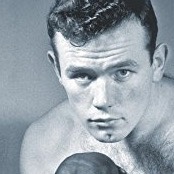
Ingemar Johansson with a boxing glove raised. His jab helped create openings for the right hand that made him world champion.
Johansson was born in Gothenburg, Sweden, on September 22, 1932. He became a leading Swedish amateur and reached the heavyweight final at the 1952 Helsinki Olympics against American Ed Sanders.
The final ended in disqualification for passivity. Johansson stayed out of range and threw too few punches, drawing repeated warnings from the referee. Although he had reached the final, he was excluded from the medal ceremony and did not receive the silver medal at the time.
The medal was finally awarded in 1982. Describing him simply as a 1952 silver medalist misses that important qualification. His later professional success transformed his reputation, but it did not make the circumstances of the Olympic final disappear.
Johansson turned professional in 1952. On September 30, 1956, he knocked out Franco Cavicchi in the thirteenth round in Bologna, establishing himself as European heavyweight champion. He also recorded victories over British heavyweights Henry Cooper and Joe Erskine as his international standing grew.
His boxing was built around a left jab and an exceptionally damaging right. The jab could measure distance, occupy an opponent’s attention and prepare the opening for a sudden right cross. Nicknames such as “Ingo’s Bingo” and the “Hammer of Thor” captured the punch’s reputation, but the setup was an important part of its effectiveness.
Johansson working with a training bag in an archival photograph shared by The Loneliest Sport.
On September 14, 1958, Johansson faced Eddie Machen at Ullevi in Gothenburg. Machen was an established American contender and the bout offered Johansson a direct test against one of the heavyweight division’s leading men.
Johansson knocked him down three times and won by first-round knockout. A fight intended to measure his place in the world rankings instead demonstrated how abruptly his right hand could settle a contest. The victory gave his coming world-title challenge a concrete foundation: he had beaten a major contender, rather than relying solely on European success.
Johansson’s first-round knockout of Eddie Machen in Gothenburg, September 14, 1958.
Johansson challenged Floyd Patterson at Yankee Stadium in New York on June 26, 1959. Patterson was favored, but the challenger’s jab and right hand proved far more dangerous than the champion could safely accommodate.
The decisive action came in round three. Johansson’s right sent Patterson to the canvas, and the champion never fully recovered. Six further knockdowns followed before referee Ruby Goldstein stopped the contest. Seven knockdowns in a single round made it an extraordinary and punishing title change.
Johansson had become world heavyweight champion. This was the recognized championship of the era, rather than one belt among several rival heavyweight titleholders. For Swedish boxing, his victory was a landmark; internationally, it forced a reassessment of a fighter whose reputation had once been overshadowed by the Olympic controversy.
The outcome also demonstrated the limits of treating punching power as an isolated attribute. Johansson’s jab and patience had helped bring the champion into position for the decisive right. Patterson would have to change the way he fought if he was to regain the title.
The first Johansson–Patterson championship fight at Yankee Stadium, June 26, 1959.
The rematch took place at New York’s Polo Grounds on June 20, 1960. Patterson fought with greater pressure, working inside and making it harder for Johansson to establish the distance from which he could launch his right hand.
In the fifth round, Patterson’s left hook put Johansson down. After the Swede rose, another left hook ended the fight. Johansson had lost his first professional contest and his world championship in his first defense.
Patterson became the first boxer to regain the world heavyweight title. That historical milestone is inseparable from Johansson’s story: his breakthrough victory created the possibility, and the rematch supplied one of boxing’s most famous reversals.
They met for a third time on March 13, 1961, at the Miami Beach Convention Center. The opening round was spectacular. Johansson knocked Patterson down twice, briefly threatening a repeat of their first fight, before Patterson scored a knockdown of his own.
The early exchanges showed that Johansson remained dangerous even after his knockout defeat. Patterson nevertheless recovered and ultimately stopped him in the sixth round. The trilogy ended two victories to one in Patterson’s favor, with all three contests decided inside the distance.
Johansson’s two professional losses both came against Patterson. Their rivalry combined contrasting strengths, sudden knockdowns and genuine changes in approach. It remains the central passage of Johansson’s career, while the Machen victory shows that his championship success cannot be dismissed as a single fortunate result.
Johansson regained the European title by knocking out Dick Richardson in the eighth round at Ullevi on June 17, 1962. It was a meaningful regional championship success after the Patterson defeats, though it did not restore the world title.
His final professional bout was a twelve-round points victory over Brian London in Stockholm on April 21, 1963. It was a non-title contest. London knocked him down in the closing seconds, and Johansson was in difficulty when the final bell ended the fight. He never boxed professionally again.
He finished with 26 wins, two losses and 17 knockouts. Johansson died on January 30, 2009, aged 76. His place in boxing rests on the European titles, the emphatic Machen knockout and, above all, the world championship won from Patterson. His record is short beside many heavyweight champions’ careers, but its major fights were unusually consequential.
Career highlights of Ingemar Johansson, compiled by haNZAgod.
Johansson belonged to a heavyweight era that also included Sonny Liston. The retained historical video below features the two former champions; it is not presented as a competitive bout between them.
Sonny Liston and Ingemar Johansson in a historical video published by ET’s Ramblings: Boxing & Strength History.

Top Heavyweight Boxing covers the past, present and future of boxing's premier division. Copyright© 2026
Powered by Digital Dynasty Design