WORLD Heavyweight Boxing

Month
Date
,
Year
Undisputed Champion
Jack Sharkey won the world heavyweight championship in 1932, during the unsettled years between the reigns of Gene Tunney and Joe Louis. A technically accomplished contender who could box and punch, he defeated Harry Wills, Primo Carnera and Max Schmeling, while also meeting Jack Dempsey and Joe Louis. His title reign lasted just over a year, but the opposition he faced places him firmly within the history of that heavyweight generation.
Sharkey’s career was rarely straightforward. A knockout while protesting a foul, a disqualification in his first world-title attempt and a disputed decision in the rematch all shaped his reputation. Those episodes should be explained individually, rather than treated as evidence that his championship or every controversial fight was illegitimate.
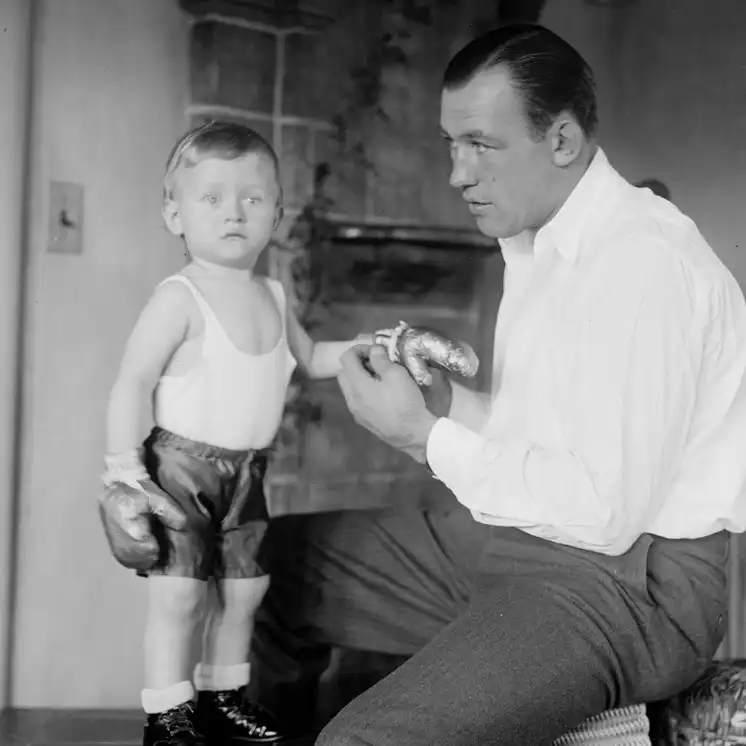
Jack Sharkey with a young child wearing boxing gloves in an archival family photograph.
Born Joseph Paul Zukauskas in Binghamton, New York, on October 26, 1902, Sharkey was the son of Lithuanian immigrants. He became associated with Boston and developed his boxing during service in the United States Navy. The nickname “Boston Gob” reflected that naval background; “gob” was a familiar term for a sailor.
He entered professional boxing in 1924 and adopted a ring name combining Jack Dempsey and the earlier heavyweight contender Tom Sharkey. His development came through competitive opposition rather than an uninterrupted series of easy victories. The mixed results of his early career helped produce a fighter comfortable with long contests and different styles.
Sharkey’s strengths lay in his ability to combine movement, a jab and close-range punching. He could be a more versatile opponent than a fighter identified primarily with one knockout punch. His subsequent championship opportunities grew from credible wins over established men, even though his performances and results did not always follow a steady upward line.
Retained career highlights illustrating Sharkey’s boxing style.
On October 12, 1926, Sharkey met Wills at Ebbets Field in Brooklyn. Wills had long pursued a heavyweight championship opportunity and was one of the division’s most important contenders. Sharkey took the initiative and built a commanding advantage before Wills was disqualified in the thirteenth round for an illegal backhand blow.
The official result was a disqualification, but contemporary reporting described Sharkey as the superior fighter throughout much of the contest. It was therefore more than a victory obtained through an isolated rules violation. He had shown that he could compete successfully against a physically larger and highly experienced heavyweight.
Wins over Mike McTigue and Jim Maloney followed in 1927. They helped secure a meeting with Dempsey, whose own goal was a rematch with the reigning champion, Tunney. Sharkey had progressed from regional prospect to a central figure in the championship picture.
Sharkey fought Dempsey at Yankee Stadium on July 21, 1927, with a title opportunity against Tunney awaiting the winner. Sharkey’s speed and clean punching made him competitive from the opening rounds. The contest demonstrated that he possessed the ability to trouble a former champion of exceptional standing.
The decisive moment came in the seventh round. Believing he had been hit low, Sharkey turned toward the referee to complain and lowered his protection. Dempsey landed a left hook and Sharkey was counted out. The official result was a seventh-round knockout for Dempsey; Sharkey’s complaint did not overturn it.
The ending has remained part of the fight’s historical debate. What is clear is that Sharkey interrupted his own defense during a live exchange. His earlier success did not protect him from the consequences of that moment. Dempsey advanced to the Tunney rematch, and Sharkey had to rebuild his route to the championship.
After Tunney retired in 1928, the heavyweight title needed a new claimant. Sharkey’s continued victories kept him near the front of the contest. In 1929 he defeated Tommy Loughran at Yankee Stadium, adding an important win over a respected former light-heavyweight champion.
Sharkey and Schmeling met for the vacant world heavyweight championship at Yankee Stadium on June 12, 1930. Sharkey started effectively and won the opening rounds, but a low blow in the fourth brought a disqualification. Schmeling became champion through the referee’s ruling.
This was a vacant-title fight, rather than a successful defense by Schmeling or the loss of an existing Sharkey reign. It also differed from the Dempsey ending: in 1930 the referee upheld the foul and ruled against Sharkey. The defeat left him needing another opportunity to establish himself as champion through a completed contest.
Retained footage of Sharkey’s first championship meeting with Schmeling, which ended in a fourth-round disqualification.
Sharkey faced Carnera at Ebbets Field on October 12, 1931. Despite a substantial weight disadvantage, he won a unanimous decision over fifteen rounds and knocked Carnera down in the fourth. His movement and more developed boxing were effective against an opponent whose dimensions alone did not decide the contest.
That win strengthened the case for a Schmeling rematch. On June 21, 1932, at the Madison Square Garden Bowl in Long Island City, Sharkey received a split decision after fifteen rounds and became world heavyweight champion.
The decision was controversial. Two officials favored Sharkey, while the third favored Schmeling, and many observers believed the defending champion had done enough to retain the title. The disagreement belongs in an account of the fight, but the official victory and championship transfer were Sharkey’s. He had finally reached the position that had eluded him in 1927 and 1930.
Sharkey’s first championship defense came against Carnera on June 29, 1933, again at the Madison Square Garden Bowl. Their earlier meeting suggested that Sharkey’s skill could overcome the challenger’s size. The second contest ended differently: Carnera knocked him out in the sixth round with a right uppercut.
Rumors about the fight’s legitimacy circulated, but Sharkey denied deliberately losing, and prominent ringside observers accepted Carnera’s victory as genuine. Speculation should not be presented as an established fixed result. The recorded outcome is a sixth-round knockout and the end of Sharkey’s world-title reign.
The reversal also illustrates why an earlier decision victory does not guarantee a successful rematch. Sharkey had beaten Carnera over fifteen rounds in 1931; in 1933 he could not avoid the punch that transferred the championship. His reign ran from June 21, 1932, to June 29, 1933.
Sharkey continued fighting after losing the title, but did not regain his previous position. His final professional appearance came against Louis at Yankee Stadium on August 18, 1936. Louis was returning from his own defeat by Schmeling and stopped Sharkey in the third round.
That contest brought together two different stages of heavyweight history. Sharkey had fought Dempsey in 1927 and now faced the man who would become the division’s defining champion after winning the title in 1937. His own career connected those eras through direct competition rather than retrospective comparison.
In retirement Sharkey remained involved in boxing as a referee and through public appearances. He was inducted into the International Boxing Hall of Fame in 1994 and died on August 17 that year, aged 91. His place in heavyweight history rests on the quality of his opposition, his championship victory and the skill evident in his best performances.
An archival photograph of Jack Sharkey and his wife Dorothy at home.
— Heavyweight History (@HVYWeightHeroes) May 10, 2023
Sharkey and his wife Dorothy in the retained archival post. Its approximate 1931 photograph date predates his championship victory in June 1932.

Top Heavyweight Boxing covers the past, present and future of boxing's premier division. Copyright© 2026
Powered by Digital Dynasty Design