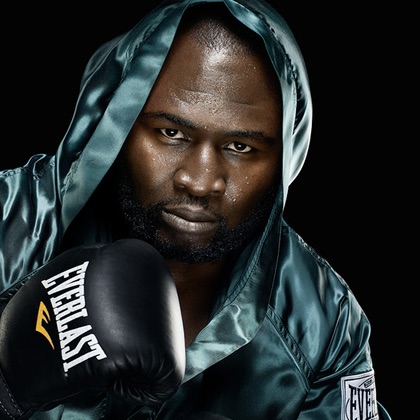
James “Lights Out” Toney brought the skills of an accomplished middleweight, super-middleweight and cruiserweight champion into the heavyweight division. His compact defence, close-range counterpunching and ability to work under pressure made him competitive against much larger men. A stoppage victory over Evander Holyfield and a draw with defending WBC champion Hasim Rahman established that his heavyweight ambitions had substance.
Toney’s championship history also requires precision. His apparent WBA heavyweight title win over John Ruiz in 2005 was overturned after a positive drug test, and the championship was restored to Ruiz. Toney was a recognised world champion in three weight divisions and a leading heavyweight contender; the overturned Ruiz result must not be counted as an enduring fourth-division championship achievement.
James Toney, whose defensive craft carried him from middleweight championship boxing into heavyweight contention.
Championship Foundations at Middleweight
Born in Grand Rapids, Michigan, on August 24, 1968, Toney began his professional career in 1988. His development produced a fighter who was comfortable at close quarters, where small changes in shoulder position and balance could make an opponent miss without requiring a retreat across the ring.
In May 1991 he stopped Michael Nunn in the eleventh round to win the IBF middleweight championship. Nunn had been ahead on the scorecards, but Toney found the opening that transformed the fight. The result demonstrated the patience and counterpunching ability that would remain central to his career.
Toney subsequently defended against accomplished opposition, including Reggie Johnson and Mike McCallum. Those contests helped establish that he was more than a surprise title winner. He could compete with experienced, technically sophisticated champions over the full distance.
Barkley, Jones and the Road to Cruiserweight
In February 1993 Toney defeated Iran Barkley to win the IBF super-middleweight championship, with Barkley withdrawn after nine completed rounds. The performance displayed his ability to combine defence with sustained, accurate offence rather than treat the shoulder roll as an end in itself.
He lost that title to Roy Jones Jr. in November 1994. Jones’s speed and movement produced a clear decision victory, an important limit on any claim that Toney’s style was beyond solving.
Toney’s later route through heavier divisions was uneven, but he remained capable of exceptional performances. The move to cruiserweight eventually supplied the opportunity to show that his ring intelligence could still overcome a younger champion’s pressure and work rate.
The Jirov Fight and a Third Division
On April 26, 2003, Toney challenged Vassiliy Jirov for the IBF cruiserweight title at Foxwoods in Connecticut. Jirov pressed forward and maintained a demanding pace; Toney answered with counters and combinations from positions that often appeared uncomfortable.
The contest was physically hard rather than a simple exhibition of effortless defence. Toney had to work through Jirov’s body attack, find accurate return punches and sustain his concentration over twelve rounds. A final-round knockdown helped secure his unanimous decision.
The result gave Toney a major world championship in a third division. It also provided the sporting foundation for his next move. He was entering heavyweight boxing after defeating a reigning cruiserweight champion, not merely trading on achievements from a decade earlier.
Stopping Evander Holyfield
On October 4, 2003, Toney faced Evander Holyfield in Las Vegas. Holyfield was a former heavyweight champion, and the contest was a non-title fight.
Toney’s timing and inside work repeatedly found openings. He absorbed and deflected attacks, then answered with combinations that made Holyfield increasingly ineffective. The fight ended in a ninth-round technical knockout.
The victory was an important heavyweight achievement, although its context matters: Holyfield was forty and well past his strongest championship years. Toney defeated a great former champion, not the peak version who had fought Bowe and Tyson.
The performance nevertheless showed that his technique could function against heavyweight size. He did not need to become a tall, long-range boxer to compete; his approach depended on controlling exchanges close enough to use his strengths.
John Ruiz and the Overturned WBA Result
On April 30, 2005, Toney challenged John Ruiz for the WBA heavyweight championship at Madison Square Garden. He initially received a twelve-round unanimous decision and appeared to have added a heavyweight belt to his earlier titles.
A positive test for nandrolone led New York authorities to overturn the victory. The official outcome became a no decision, commonly described as a no contest, and the WBA restored championship recognition to Ruiz.
The change is fundamental to an accurate biography. The performance remains part of Toney’s heavyweight career, but the original decision cannot be presented as a valid championship win. His recognised middleweight, super-middleweight and cruiserweight achievements stand independently of that overturned result.
Challenging WBC Champion Hasim Rahman
On March 18, 2006, Toney met Hasim Rahman at Boardwalk Hall in Atlantic City. Rahman was defending the WBC heavyweight championship, not entering merely as a former champion.
The fight ended in a twelve-round majority draw. One judge favoured Rahman, while two scored the contest even. Rahman retained his title; Toney had competed through a full championship distance without securing the belt.
The contrast between their methods made the contest demanding to assess. Rahman supplied greater activity, while Toney relied on defence and selected counters. Debate about the scoring does not alter the official draw or the champion’s successful retention.
Two Eliminators Against Samuel Peter
Toney next faced Samuel Peter in a WBC title eliminator on September 2, 2006. Peter won a split decision in Los Angeles, with the verdict attracting substantial disagreement.
Toney’s cleaner counterpunching made a case for him, while Peter’s strength and heavier shots gave the judges a different set of qualities to weigh. The result was sufficiently controversial for the WBC to order a rematch.
On January 6, 2007, in Hollywood, Florida, Peter won much more clearly. He used his jab effectively, knocked Toney down in the second round and took a wide unanimous decision. Neither contest was a defence of a world heavyweight title by Peter, who won the full WBC championship later.
The series showed both the continuing value and the limitations of Toney’s heavyweight style. His craft could make a powerful opponent’s work untidy, but it did not guarantee that he could control the pace or produce enough offence to win.
The Rahman Rematch and Later Competition
Toney and Rahman met again on July 16, 2008, in Temecula, California. This time no major world heavyweight championship was at stake. An accidental clash of heads cut Rahman, and the fight ended after three rounds.
Toney was initially awarded a stoppage victory. Following review, the California State Athletic Commission changed the result to a no contest because the accidental head clash had caused the ending. The official rematch result is therefore neither a Toney victory nor a Rahman decision win.
Toney continued competing for years after his strongest heavyweight period. His prolonged career does not change the distinction between major world championships, smaller organisational belts and contender-level contests.
The Heavyweight Value of Old-School Craft
Toney’s heavyweight career is best understood as a technical achievement with clear qualifications. He stopped a famous former champion, fought a defending WBC champion to a draw and contested important eliminators, but did not establish a valid major heavyweight championship reign.
His lasting influence comes from the skill involved in those performances: reading an opponent’s balance, making small defensive movements and answering immediately from close range. Those abilities allowed a fighter formed at middleweight to remain relevant against much larger men.
The overturned results belong in that history rather than outside it. An accurate assessment can recognise Toney’s exceptional boxing ability while retaining the official outcomes that define his championship record.