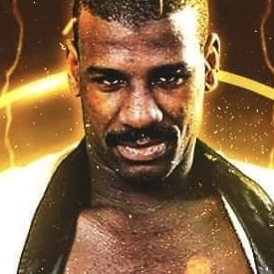
Michael Spinks accomplished something no reigning world light heavyweight champion had done before: he moved up and defeated the heavyweight champion. His 1985 victory over Larry Holmes was the peak of a career that already included Olympic gold and an undisputed light heavyweight reign. The speed of his final defeat by Mike Tyson often dominates memories of Spinks, but his earlier achievements place him among boxing’s most accomplished champions.
Michael Spinks in a boxing robe. His success at heavyweight followed an outstanding championship career at light heavyweight.
Olympic gold and the Spinks boxing family
Spinks was born in St. Louis, Missouri, in 1956. He won the middleweight gold medal for the United States at the 1976 Montreal Olympics and turned professional in 1977. His brother, Leon Spinks, also became a world heavyweight champion, making theirs one of boxing’s most distinctive championship families.
Michael’s path was patient and sustained. Rather than moving directly into heavyweight contention, he developed into an elite light heavyweight. His long reach, unusual rhythm and forceful right hand gave him several ways to control a contest. The right was known as the “Spinks Jinx,” but his success depended on more than a single punch.
Becoming the undisputed light heavyweight champion
Spinks stopped former champion Marvin Johnson in March 1981, then defeated Eddie Mustafa Muhammad by unanimous decision over fifteen rounds on July 18 to win the WBA light heavyweight championship. That title established him at the top of a strong division.
On March 18, 1983, he faced WBC champion Dwight Muhammad Qawi, formerly known as Dwight Braxton, in a unification bout. Qawi’s pressure presented a very different challenge from fighting at comfortable long range. Spinks won a fifteen-round unanimous decision and became the undisputed world light heavyweight champion. He subsequently held the IBF title as well.
His championship career showed that his awkward style was repeatable against high-level opposition. He could box, vary the pace and deliver damaging punches without depending on conventional combinations. Moving to heavyweight would ask whether those strengths could survive a substantial increase in his opponents’ size.
Ending Larry Holmes’s unbeaten run
On September 21, 1985, Spinks challenged Larry Holmes at the Riviera in Las Vegas. Holmes entered with a 48–0 record and a long-established claim to the heavyweight championship. Spinks weighed 200 pounds to Holmes’s 222, a significant disadvantage against a champion famous for his jab.
Spinks used movement and changes of rhythm to make the contest difficult to settle into Holmes’s preferred pattern. After fifteen rounds, all three official judges favored Spinks: two by one point and the third by three. It was a close unanimous decision, with contemporary unofficial scores divided over the winner.
The result transferred the IBF belt and the lineal championship to Spinks. He became the first reigning world light heavyweight champion to win the world heavyweight championship, while Holmes suffered his first professional loss. Spinks had not merely survived the larger man; he had won the official decision across a full championship distance.
Highlights of the first Larry Holmes–Michael Spinks fight, September 21, 1985, compiled by Jimmy Pince.
A disputed rematch with Holmes
The rematch took place at the Las Vegas Hilton on April 19, 1986. Again it lasted fifteen rounds, but this time the decision was split. One judge scored the bout 144–141 for Holmes; the other two favored Spinks, 144–142 and 144–141.
Holmes and many observers disputed the result. Contemporary unofficial scorecards also disagreed, making a blanket claim that Spinks clearly dominated inappropriate. The official record is two victories for Spinks, with the second surrounded by a particularly persistent scoring controversy.
The rematch confirmed how hard it was for either boxer to establish decisive separation. It also gave Spinks thirty rounds of experience against one of the division’s best technicians while preserving his unbeaten record and IBF title.
Highlights of the Holmes–Spinks rematch, April 19, 1986, compiled by Jimmy Pince.
Stopping European champion Steffen Tangstad
Spinks defended his IBF championship against Norway’s Steffen Tangstad at the Las Vegas Hilton on September 6, 1986. Tangstad was the European heavyweight champion, but he could not match Spinks’s speed and precision.
Spinks knocked him down once in the third round and twice in the fourth before the referee stopped the contest. After the difficult decisions against Holmes, this was a clear stoppage victory. It would also be Spinks’s final defense of the IBF belt.
Michael Spinks’s fourth-round stoppage of Steffen Tangstad in their 1986 IBF championship bout.
The Cooney victory and the divided championship
In February 1987, the IBF stripped Spinks for failing to meet its mandatory challenger, Tony Tucker. He instead fought Gerry Cooney at Convention Hall in Atlantic City on June 15, 1987.
Cooney was substantially heavier and was known for a dangerous left hook, but had fought infrequently since his own loss to Holmes. Spinks put him down twice in the fifth round and won by technical knockout. His ability to stop a much larger heavyweight reinforced the sporting value of his move up in weight.
The bout was not an IBF defense. Spinks still held the lineal claim derived from beating Holmes, and The Ring continued to recognize him as champion. Meanwhile the sanctioning-body belts were being unified elsewhere. That distinction explains why his eventual meeting with Tyson mattered even after Tyson had collected the WBA, WBC and IBF titles.
Highlights of Michael Spinks’s fifth-round stoppage of Gerry Cooney, June 15, 1987.
Tyson, retirement and historical significance
Spinks met Mike Tyson at Convention Hall in Atlantic City on June 27, 1988. Both were unbeaten. Tyson brought the three major sanctioning-body championships; Spinks brought the lineal claim and The Ring’s recognition.
Tyson settled the issue emphatically, knocking Spinks out in 91 seconds of the first round. It was Spinks’s only professional defeat. He retired the following month with 31 wins, one loss and 21 knockouts, and did not return to professional competition.
Inducted into the International Boxing Hall of Fame in 1994, Spinks deserves to be assessed across his whole career. Olympic gold, light heavyweight unification and the historic Holmes victory remain major achievements. The Tyson loss ended his championship claim, but it does not erase what made that claim legitimate.