HEAVYWEIGHT
BOXINGTHE DIVISION HEADQUARTERS HEAVYWEIGHTBOXING.COM
BOXINGTHE DIVISION HEADQUARTERS HEAVYWEIGHTBOXING.COM
Legendary Contender
Peter Jackson was one of the outstanding heavyweights of the late nineteenth century. Born in the Caribbean and developed as a boxer in Australia, he became an international contender whose skill earned recognition on both sides of the Atlantic. His Australian and British Empire championships, victory over George Godfrey and marathon contest with James J. Corbett made him much more than an intriguing figure denied a famous fight.
Jackson never received a contest for the recognised world heavyweight championship. The colour line was central to that exclusion: John L. Sullivan refused to defend against him, and Corbett did not give him a championship opportunity after succeeding Sullivan. Jackson’s achievements must be assessed alongside that barrier, while keeping his regional and segregated titles distinct from the world championship he pursued.
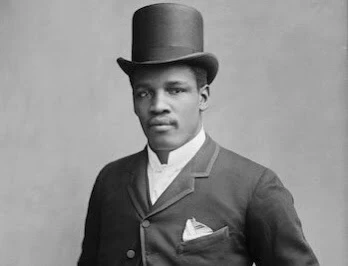
Peter Jackson, known as the Black Prince, in a formal portrait.
Jackson was born at Christiansted on St Croix, then part of the Danish West Indies. His precise birth date is disputed in historical sources, which variously place his birth in 1860 or 1861. His connection with Australia was formed through migration and work at sea, rather than an Australian birthplace.
In Sydney he developed under the guidance of Larry Foley, an important figure in Australian boxing. Jackson’s early professional experience began in the 1880s, and his progress was not an uninterrupted run of victories. Bill Farnan defeated him in an early attempt to win the Australian heavyweight championship.
Jackson subsequently established himself as a more accomplished fighter. His reputation rested on an unusual combination for a heavyweight of the period: size and strength accompanied by educated movement, a useful jab and the ability to disguise an attack. He could create an opening rather than depend exclusively on overpowering his opponent.
On September 25, 1886, Jackson stopped Tom Lees in the thirtieth round to become Australian heavyweight champion. The length of the contest belongs to the conditions of nineteenth-century boxing, when important fights could extend far beyond the later championship limit of fifteen rounds.
The victory established him nationally, but a successful Australian career was only part of his ambition. International heavyweight status required travel and encounters with opponents whose reputations had been built in Britain and the United States.
Jackson’s ability to operate in those different boxing environments became a defining strength. He carried his technical approach into longer contests and unfamiliar settings, earning a reputation that could not be confined to a local championship.
Jackson travelled to the United States in 1888. On August 24, in San Francisco, he stopped George Godfrey in nineteen rounds and won the World Colored Heavyweight Championship.
That historical title was contested in a segregated boxing system. It represented substantial competition among Black heavyweights, but it did not make Jackson the universally recognised world heavyweight champion. The distinction matters when explaining both his success and the opportunity that remained closed to him.
His ambition was to meet John L. Sullivan, holder of the main heavyweight championship. Sullivan’s refusal to fight a Black challenger was explicit. Jackson’s race, rather than a lack of serious competitive credentials, stood between him and that proposed championship contest.
On May 21, 1891, Jackson met James J. Corbett at the California Athletic Club in San Francisco. Corbett was not yet world champion. The bout was an important meeting of leading heavyweights, rather than a defence of the championship Corbett would later win.
They fought for sixty-one rounds without a winner. Contemporary reporting describes competitive early exchanges followed by an increasingly exhausted stalemate. Both men had absorbed punishment, and the referee eventually stopped a contest that was no longer producing an effective finish.
The recorded official result is a no contest. Many historical narratives use “draw” as a shorthand for the absence of a winner, but it should not be presented as an ordinary drawn points decision. Nor is there a reliable basis for awarding Jackson an unofficial victory as though it replaced the recorded outcome.
The bout demonstrated that Jackson could compete with a fighter who would soon occupy the championship. Corbett defeated Sullivan in 1892, but the sixty-one-round meeting did not lead to a championship rematch for Jackson.
On May 30, 1892, Jackson defeated fellow Australian Frank Slavin in London, stopping him in the tenth round. The contest brought together two prominent heavyweights whose rivalry had attracted considerable attention.
The victory is associated with the British Empire heavyweight championship. It was an important international success, but it should remain distinct from the world title held by Sullivan at the time.
Slavin’s defeat strengthened the sporting case for Jackson. He had won a long Australian championship contest, defeated Godfrey in America, matched Corbett across an extraordinary distance and beaten an established rival in Britain. His championship exclusion cannot be explained by treating him as an untested challenger.
Jackson’s experience illustrates how acclaim and access could diverge. He could attract spectators, gain respect from other fighters and be welcomed in influential sporting circles, while still being excluded from the most important championship contest.
Sullivan’s position was openly racial. Corbett’s failure to offer Jackson a title fight after 1892 belongs to the same broader history of restricted opportunity. The surviving record establishes that the championship meeting did not happen; it does not justify inventing a private motive for every participant or claiming that an unmade contest had a certain outcome.
Jackson’s story also needs room for what he achieved. Reducing his career entirely to exclusion leaves out the performances that made the denied opportunity consequential.
After a prolonged period with little serious competitive activity, Jackson met James J. Jeffries in San Francisco on March 22, 1898. The younger, stronger Jeffries stopped him in the third round.
Jeffries was a contender at that point, not world champion. He won the championship from Bob Fitzsimmons in 1899. The Jackson fight was therefore a non-title contest, and the result reflects a late-career Jackson rather than a direct test of the fighter at his strongest.
Jackson’s health declined, and he returned to Australia. He died of tuberculosis at Roma, Queensland, on July 13, 1901. His burial at Brisbane’s Toowong cemetery became part of the public remembrance of a fighter who had represented Australia internationally.
Jackson was inducted into the International Boxing Hall of Fame in 1990 and the Australian National Boxing Hall of Fame in 2004. His enduring standing rests on technical quality, major international results and the significance of his exclusion from a world championship opportunity.
Historical record compilations differ in their treatment of exhibitions and other nineteenth-century contests, so a single precise career tally is less useful here than a clear account of his major fights. Jackson was a champion in important competitions and a leading contender for the world crown; he never won or contested that recognised world heavyweight championship.
The Black Prince remains an essential figure in heavyweight history because both halves of his story matter: the ability he demonstrated and the championship question that boxing’s racial barriers prevented the ring from answering.

Top Heavyweight Boxing covers the past, present and future of boxing's premier division. Copyright© 2026
Powered by Digital Dynasty Design