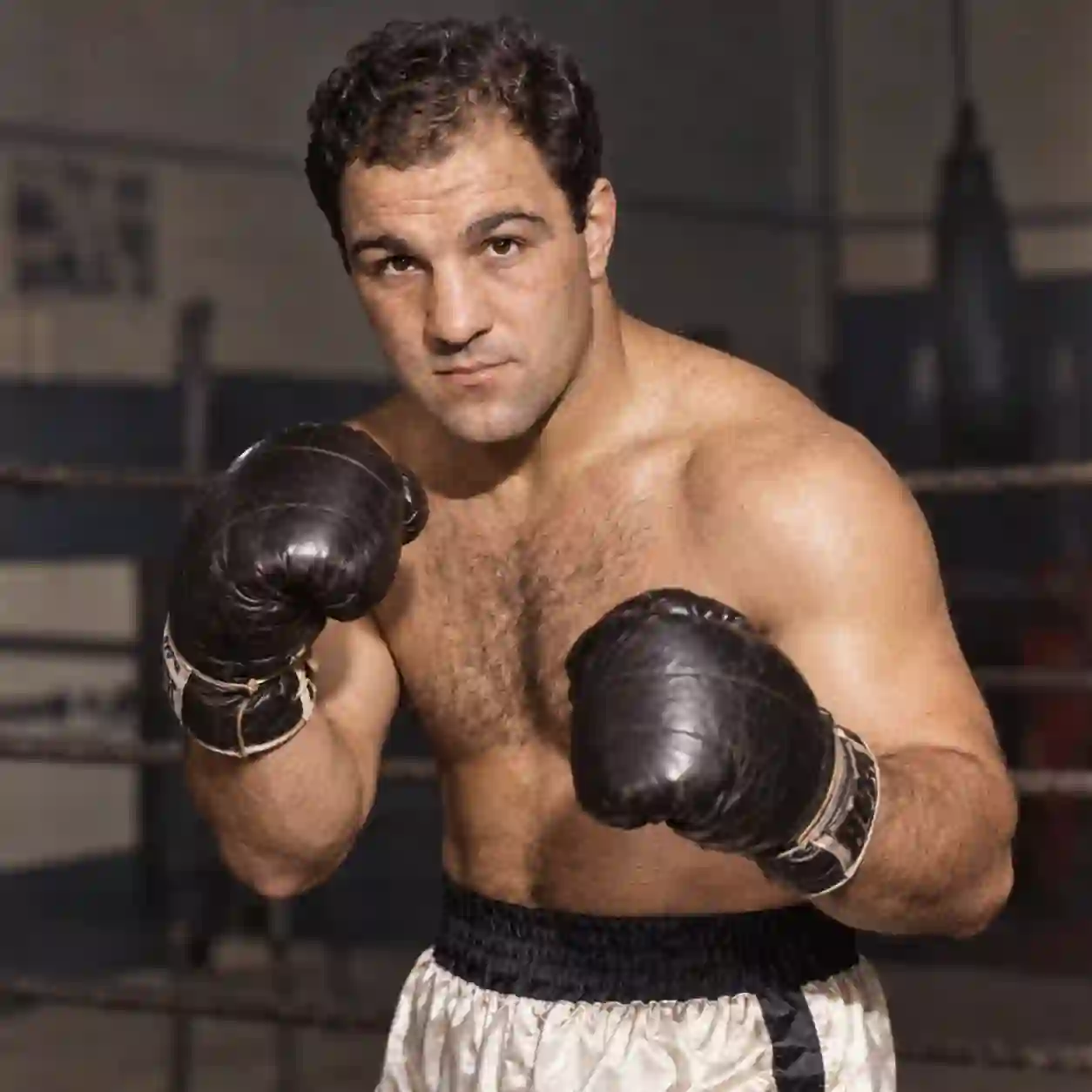
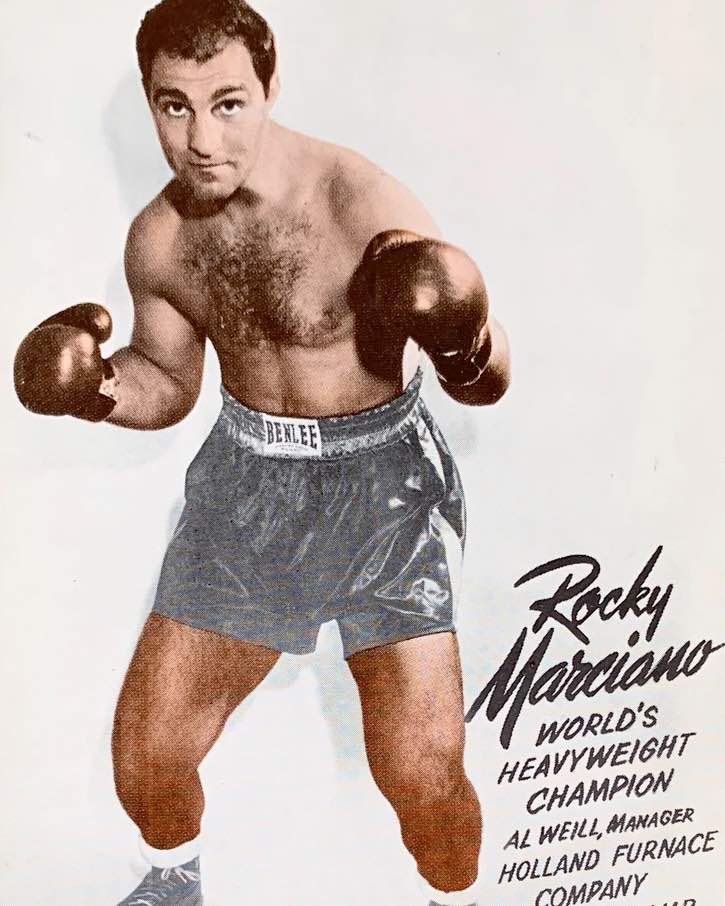
Boston, MA, USA - Rocky Marciano was the only world heavyweight champion to complete his professional career without a defeat. From 1947 to 1955, the relentless puncher from Brockton, Massachusetts, won all 49 of his fights, 43 by knockout. He captured the heavyweight championship with one of the most celebrated punches in boxing history and successfully defended it six times before walking away at the age of 32.
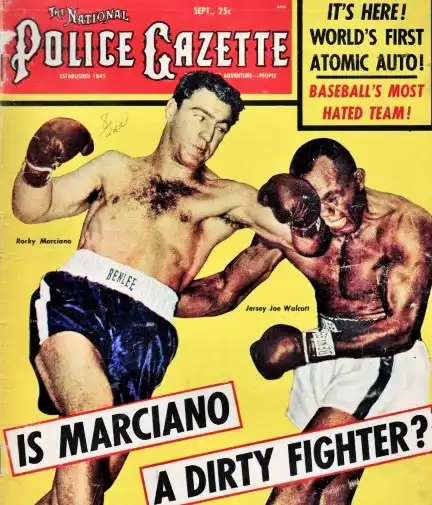
Marciano overcame an early knockdown and a points deficit to dethrone Jersey Joe Walcott with a devastating 13th-round knockout.
Marciano was not a conventional boxing prodigy. He began late, stood barely 5-foot-11 and fought with a reach of approximately 68 inches—exceptionally short for a heavyweight champion. His movements could appear awkward and his defence was built more around crouching, rolling and constant pressure than classical elegance. Yet he overcame every apparent limitation through extraordinary conditioning, physical strength, punching power and a competitive will that never weakened.
Opponents could outbox Marciano for stretches. None could keep him away forever.
From Brockton to the Army
He was born Rocco Francis Marchegiano on September 1, 1923, in Brockton, Massachusetts, the eldest son of Italian immigrants Pierino and Pasqualina Marchegiano. His father worked in a shoe factory, and the family lived modestly in a city whose economy revolved around the footwear industry.
Marciano grew into a powerful, broad-shouldered young athlete. He played baseball and football and initially dreamed of becoming a professional baseball player. Before boxing became his livelihood, he worked a succession of physically demanding jobs, including digging ditches, delivering ice and working in Brockton’s shoe factories.
He was drafted into the United States Army in 1943 during the Second World War. While stationed overseas, Marciano helped ferry supplies across the English Channel. He began boxing seriously during his military service, partly because competing allowed him to escape some of the Army’s less desirable work assignments.
After returning home, Marciano continued to pursue baseball. In 1947, he received a tryout with the Fayetteville Cubs, a minor-league affiliate of the Chicago Cubs, but was released after several weeks. His inability to throw consistently from catcher to second base effectively ended his professional baseball ambitions.
Boxing, once a secondary pursuit, became his future.
Sylvester Stallone has revealed that Rocky Marciano was the true inspiration behind ‘ROCKY’, not Chuck Wepner ❌
"A lot of people think they know who inspired Rocky, but the real inspiration was the great Rocky Marciano.
Marciano fought briefly as an amateur before turning professional. His first recorded professional appearance came under the name Rocky Mack in March 1947, when he knocked out Lee Epperson in the third round. He then returned to amateur competition before beginning his professional career in earnest the following year.
Manager Al Weill and trainer Charley Goldman saw possibilities in Marciano that were easy for others to miss. Goldman understood that his fighter would never succeed by boxing at long range. Marciano was short, had unusually short arms and had begun learning the sport much later than most leading professionals.
Instead of trying to remake him into a conventional heavyweight, Goldman built a style around Marciano’s natural assets. He taught him to fight from a low crouch, reduce the target available to taller opponents and drive upward with punches thrown from unconventional angles. Marciano learned to slip, roll and weave his way inside, where his strength and short, crushing punches could take over.
The results were devastating. Marciano won his first 16 fights by knockout and quickly developed a reputation throughout New England. He was still raw, but his conditioning, aggression and capacity to sustain an attack separated him from ordinary prospects.
His December 1949 fight with Carmine Vingo demonstrated both Marciano’s power and the brutal realities of the era. Vingo was knocked unconscious in the sixth round and suffered a serious brain injury. Marciano visited him in hospital and was deeply affected by the experience. Vingo eventually recovered, but never fought again.
Rocky Marciano was one of the most beloved champions of boxing’s golden age, and generations later his perfect record, crushing power and unbreakable determination continue to make him one of the most admired heavyweights in the sport’s history.
Becoming a contender
Marciano’s first major test came against the clever and undefeated Roland La Starza in March 1950. La Starza’s movement and technique gave Marciano enormous difficulty, but Marciano prevailed by a narrow split decision. It was the only fight of his professional career in which the result was seriously disputed.
As the opposition improved, Marciano continued to win. He stopped respected contender Rex Layne in six rounds in July 1951, breaking through with a right hand that confirmed his arrival among the division’s leading challengers.
Three months later, Marciano entered the ring against former heavyweight champion Joe Louis at Madison Square Garden. Louis was 37 and far removed from the fighter who had ruled the division for nearly 12 years, but he remained the most famous name in boxing and Marciano’s childhood hero.
Marciano stopped Louis in the eighth round, knocking him through the ropes with a final right hand. The victory elevated Marciano into the highest level of the division, but it brought him little personal satisfaction. He reportedly wept afterward and visited Louis in his dressing room. Marciano had achieved the defining victory of his young career by ending the career of the fighter he had admired most.
Victories over Lee Savold and Harry “Kid” Matthews followed, earning Marciano a challenge for the heavyweight championship.
The punch that won the championship
On September 23, 1952, Marciano challenged Jersey Joe Walcott at Municipal Stadium in Philadelphia. Walcott was a gifted and experienced champion whose boxing ability presented Marciano with the most difficult test of his career.
Walcott dropped Marciano with a left hook in the opening round—the first knockdown suffered by Marciano as a professional—and controlled much of the fight with his movement, timing and counterpunching. Marciano pressed forward relentlessly but entered the 13th round behind on the scorecards.
Then came the punch that defined his career.
As Walcott backed toward the ropes and prepared to throw a right hand, Marciano drove his own right into the champion’s jaw. The blow, later immortalized as the “Suzie Q,” collapsed Walcott against the ropes. He was counted out with his arm hanging over the bottom strand.
With one short right hand, Marciano had erased a points deficit and become heavyweight champion of the world.
The rematch lasted only 2:25. Marciano knocked Walcott out in the first round in Chicago on May 15, 1953.
The size difference between a 1950s heavyweight and a 2020s heavyweight is wild 🤯
How do you think a mythical matchup between Rocky Marciano and Tyson Fury would go? pic.twitter.com/BTwuULTDWs
Marciano made six successful defences of the heavyweight championship, with five ending inside the distance.
His second defence came against Roland La Starza, who had pushed him so closely three years earlier. This time there was no debate. Marciano subjected La Starza to sustained punishment before the fight was stopped in the 11th round.
Former champion Ezzard Charles presented a more complicated challenge. An outstanding technician who had reigned as both heavyweight champion and the leading light heavyweight of his generation, Charles took Marciano the full 15 rounds at Yankee Stadium in June 1954. Marciano won a unanimous decision, becoming the only man ever to defeat Charles over the 15-round distance.
Their rematch three months later produced one of the most dramatic fights of Marciano’s career. Charles opened a severe cut along Marciano’s nose, placing the champion in danger of losing the title on a stoppage. Knowing time was running out, Marciano intensified his attack and knocked Charles out in the eighth round.
Marciano next travelled to San Francisco to face British champion Don Cockell in May 1955. Cockell survived repeated barrages before being stopped in the ninth round.
For his final appearance, Marciano met light heavyweight champion Archie Moore at Yankee Stadium on September 21, 1955. Moore was one of boxing’s greatest and most experienced fighters, and he dropped Marciano with a right hand in the second round. Marciano rose, resumed his advance and gradually overwhelmed the challenger. Moore went down several times before being counted out in the ninth.
Marciano had completed his final fight in the same fashion as most of the others: moving forward, breaking down resistance and finishing with a knockout.
An unmatched engine
Marciano’s boxing was more sophisticated than its rough appearance suggested. His low crouch made him difficult to hit cleanly, while his constant movement forced taller opponents to punch downward at an awkward target. He was adept at rolling under punches and returning with hooks and overhand rights from unexpected angles.
His greatest weapon was his right hand, but Marciano was not dependent upon a single punch. He attacked the arms, shoulders, body and head, treating anything within reach as a legitimate target. Even blocked punches took a toll. Opponents who boxed effectively early often found their movement slowing as the rounds passed and Marciano’s pressure continued without relief.
Few heavyweight champions have matched his conditioning. Marciano trained with an almost obsessive intensity, running long distances through the hills around Brockton and working until he was prepared to maintain his attack for 15 rounds. He possessed unusual stamina, a strong chin and complete confidence that any fight could be won as long as he remained standing.
His punches did not merely score points. They altered fights.
Retirement
Marciano announced his retirement on April 27, 1956. He was 32 years old, had been heavyweight champion for more than three years and had nothing left to prove. He cited his desire to spend more time with his wife, Barbara, and their children, Mary Anne and Rocco Kevin.
He received several lucrative offers to return, including serious discussion of a fight with rising star Floyd Patterson, but resisted them. Marciano had seen Joe Louis return out of financial necessity and understood the danger of remaining in boxing too long.
He retired with a professional record of 49-0 (43 KOs). Although other champions have since surpassed 49 consecutive professional victories, Marciano remains the only heavyweight champion to end his career undefeated and never return to the ring.
Death and legacy
After boxing, Marciano remained a popular public figure. He appeared on television, worked as a commentator, attended sporting events and travelled frequently for personal appearances and business engagements.
On August 31, 1969, the eve of his 46th birthday, Marciano was a passenger in a small private aircraft travelling through severe weather in Iowa. The plane crashed near Newton, killing Marciano, pilot Glenn Belz and fellow passenger Frankie Farrell.
Marciano’s place among the greatest heavyweight champions continues to inspire debate. Critics point to his size, his relatively short championship reign and the advanced ages of several famous opponents. His supporters answer with the perfect record, six successful title defences, 43 knockouts and victories over every leading opponent placed in front of him.
What cannot reasonably be questioned is the force of his championship years. Marciano defeated Walcott twice, Charles twice, La Starza twice, and also stopped Louis, Moore, Layne, Matthews, Savold and Cockell. He was never defeated, never held to a draw and never failed to rise after being knocked down.
Rocky Marciano was not the largest or most graceful heavyweight champion. He was something rarer: a fighter whose physical limitations became part of his strength. He forced every opponent into a contest of endurance, courage and attrition—and across 49 professional fights, no one found a way to beat him.
From the sheer skill, power and force these athletes bring to the squared circle, heavyweight champions influence far more than the action in the ring.
Born in 1923 to Italian immigrant parents in Brockton, Massachusetts, Rocky Marciano soared from a shoemaker's son to Heavyweight Champion of the World.