HEAVYWEIGHT
BOXINGTHE DIVISION HEADQUARTERS HEAVYWEIGHTBOXING.COM
BOXINGTHE DIVISION HEADQUARTERS HEAVYWEIGHTBOXING.COM
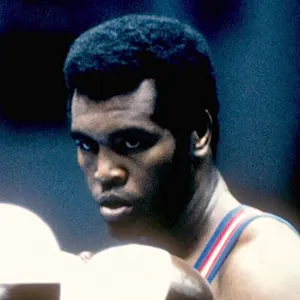
Amateur Legend
Teófilo Stevenson won three consecutive Olympic heavyweight gold medals for Cuba, in Munich in 1972, Montreal in 1976 and Moscow in 1980. His achievements were not a prelude to a professional championship career: they were the centre of a life spent in amateur boxing. Alongside those Olympic victories, he won three World Championships and became one of the defining figures of Cuba's national boxing programme.
Teófilo Stevenson, Cuba's three-time Olympic heavyweight gold medallist.
Stevenson was born on March 29, 1952, in Puerto Padre, in eastern Cuba. He emerged internationally at the 1971 Pan American Games, taking bronze after losing to American heavyweight Duane Bobick. The setback established an important rivalry ahead of the following year's Olympics.
His long reach, controlled jab and powerful right hand suited the short, intense contests of amateur tournament boxing. He could establish distance and threaten a stoppage without turning every exchange into a brawl. His championship record also required repeated performances through successive tournament rounds, rather than success in a single showcase fight.
At the Munich Olympics, Stevenson reversed his earlier defeat by stopping Bobick in their quarter-final. It was a decisive result against a highly regarded American opponent and helped make Stevenson one of the most closely watched fighters at the Games.
He then stopped West Germany's Peter Hussing in the semi-final. The gold-medal bout did not take place: Romania's Ion Alexe was unable to compete because of an injured thumb, and Stevenson won the final by walkover. That distinction preserves the actual tournament result without diminishing the victories that carried him to the final.
Stevenson also received the Val Barker Trophy, the award for the outstanding boxer of those Olympics. His first gold placed him in the heavyweight succession after Joe Frazier in 1964 and George Foreman in 1968, although his subsequent career followed a different path from those professional champions.
By Montreal, Stevenson was the reigning Olympic and world amateur champion. He won all four of his contests inside the distance, demonstrating that his first Olympic success had been the beginning of a sustained period at the top.
In the semi-final he stopped John Tate in the first round. Tate later became WBA heavyweight champion as a professional, but in Montreal he could not withstand Stevenson's attack. Stevenson secured his second Olympic gold when Romania's Mircea Şimon retired in the final.
The tournament displayed the effectiveness of Stevenson's combination of reach, timing and finishing power. His opponents had only a few rounds in which to solve a difficult tactical problem, while a mistake could bring the contest to an immediate end.
Stevenson's third Olympic campaign ended with a decision over Soviet heavyweight Pyotr Zayev in the final. Unlike his stoppage-heavy run in Montreal, the closing rounds in Moscow required him to win on points: he also defeated Hungary's István Lévai by decision in the semi-final.
The victory made Stevenson the first boxer to win three Olympic gold medals in the same weight division. He was not the first boxer with three Olympic golds overall; Hungary's László Papp had already achieved that total across middleweight and light-middleweight.
All three of Stevenson's Olympic championships were officially heavyweight titles in the open-ended division above 81 kilograms. They should not be retrospectively labelled Olympic super-heavyweight titles, a separate category introduced later.
Stevenson won world amateur titles in 1974, 1978 and 1986, and Pan American gold medals in 1975 and 1979. These results show the breadth of his international success beyond the Olympic cycle.
His 1986 World Championships victory came in the super-heavyweight division in Reno, Nevada. Born in March 1952, he was 34 at that tournament. The later weight classification belongs to that world-title campaign, rather than to his three earlier Olympic gold medals.
Cuba did not attend the 1984 or 1988 Olympics, so Stevenson had no opportunity to pursue another Olympic title at either Games. Those absences are part of the historical record; they do not establish that a fourth gold would have been certain.
Stevenson remained an amateur despite interest from professional promoters. His place in boxing history rests on the championships he actually won, not on predictions about hypothetical professional opponents. The different rules, distances and career structures make imagined comparisons an unreliable substitute for his documented achievements.
He died in Havana on June 11, 2012, aged 60. Three Olympic gold medals and three world amateur championships remain a clear measure of his importance: he sustained elite international heavyweight success across several generations of opponents while representing a boxing tradition distinct from the professional title circuit.

Top Heavyweight Boxing covers the past, present and future of boxing's premier division. Copyright© 2026
Powered by Digital Dynasty Design