WORLD Heavyweight Boxing

Month
Date
,
Year
Legendary Contender
Tommy “Hurricane” Jackson was an American heavyweight contender whose unconventional attacks and exceptional persistence carried him to a world-title challenge in 1957. He defeated former champion Ezzard Charles twice and earned a close decision over Bob Baker, but never won the world heavyweight championship.
His two meetings with Floyd Patterson had different stakes and different outcomes. Patterson won their 1956 title eliminator by split decision. When Jackson challenged him for the championship in 1957, Patterson stopped him in the tenth round. Jackson’s place in boxing history rests on a genuine contender’s achievements and a distinctive style, not a championship reign.
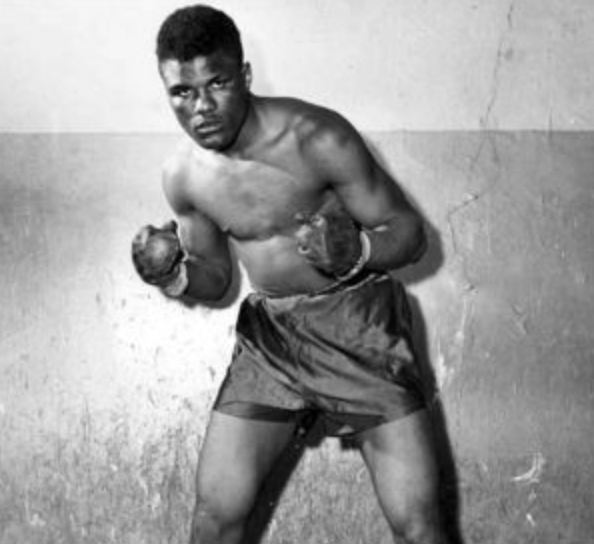
Tommy “Hurricane” Jackson posing in his boxing stance.
Thomas Jackson was born on August 9, 1931, in Sparta, Georgia. His later association with New York boxing sometimes obscures that birthplace. He began his professional career in 1951 and became a prominent heavyweight during the middle of the decade.
Jackson’s rise took place in a division moving through the reigns of Charles, Jersey Joe Walcott and Rocky Marciano. When Marciano retired in 1956, the championship became available to a new generation of contenders. Jackson had already produced results strong enough to put him into that discussion.
His development did not follow the model of a composed, economical technician. He relied on activity, awkward rhythms and the willingness to continue exchanges that more conventional boxers might have broken off. Those qualities could unsettle opponents, although they also left openings for accurate counterpunches.
Jackson’s nickname suited the impression he created in the ring. His attacks could include sweeping punches, unexpected combinations and double uppercuts. He was difficult to measure solely against textbook technique because much of his effectiveness came from disrupting an opponent’s expectations.
That did not make him impossible to hit. His strongest performances depended on sustained effort and the ability to keep an experienced opponent occupied, rather than flawless defence. Against men who could maintain their balance and find clear targets, the same approach could lead to heavy punishment.
Jackson deserves to be treated as a serious competitor rather than merely a colourful curiosity. His style attracted attention, but victories over established heavyweights gave that attention sporting substance. He reached contention through results, not just through the novelty of his movement.
A July 1954 defeat to Nino Valdes demonstrated the danger of meeting a powerful, established heavyweight before Jackson could impose his own pace. Valdes stopped him in the second round, a sharp interruption to his progress.
Jackson continued competing and rebuilt his standing. His subsequent success was important because it showed that the early stoppage did not define his ceiling. He could improve his position against experienced opposition and earn a place in the championship picture.
The division offered no easy route. Fighters such as Charles and Baker had substantial experience at the highest level, and defeating them required Jackson to sustain his awkward pressure across a full contest rather than rely on a single surprising exchange.
Jackson defeated Ezzard Charles twice in August 1955, winning ten-round unanimous decisions on August 3 and August 31. The second contest took place in Cleveland, less than a month after the first.
Charles had already held the world heavyweight championship and had challenged Marciano twice in 1954. By the Jackson fights he was a former champion whose long career and recent championship battles formed an important part of the context.
Neither Jackson victory was a world-title win. Both were nevertheless significant results against a highly accomplished opponent, and the quick repeat success showed that Jackson’s first victory had not been a solitary favourable night.
The proper balance is to recognise both men’s circumstances. Charles was past his championship peak, but his experience and skill still made him a meaningful test. Jackson’s victories helped convert an unusual fighting personality into an established contender.
On February 3, 1956, Jackson defeated Bob Baker by majority decision over ten rounds at Madison Square Garden. The close result added another substantial win to his record before the question of Marciano’s successor became immediate.
Jackson then met Patterson at Madison Square Garden on June 8, 1956, in a twelve-round eliminator. Marciano had retired, so this was a contest in the process of establishing a new champion rather than a defence by Patterson.
Patterson won a split decision. Jackson had taken him through twelve competitive rounds, but the official outcome moved Patterson forward towards the vacant championship. Patterson subsequently defeated Archie Moore to win the title.
Jackson’s first Patterson fight therefore belongs to his contender story. It did not make him a champion or represent a failed defence of a belt he had held. It supplied the background for the championship rematch the following year.
On July 29, 1957, Jackson challenged Patterson at New York’s Polo Grounds. Patterson entered as the reigning world heavyweight champion, making his first title defence; Jackson entered as the challenger.
The rematch was much more decisive than their eliminator. Patterson’s speed and concentrated combinations repeatedly penetrated Jackson’s defence. Jackson was knocked down in the first, second and ninth rounds, yet continued until referee Ruby Goldstein stopped the contest at 1:52 of the tenth.
The result was a tenth-round technical knockout for Patterson. It was not a fifteen-round decision, and Patterson was not a former champion on that night. Those distinctions are essential to an accurate account of Jackson’s most important fight.
Jackson’s determination to continue was evident, but the championship exposed the limitations of his defence against an exceptionally quick opponent. The fight demonstrated both the courage that carried him into contention and the punishment that could result when that courage was not matched by effective protection.
Jackson faced Eddie Machen at the Cow Palace in California on November 13, 1957. Machen knocked him down in the opening round and controlled the fight. With Jackson’s right eye swollen closed after ten completed rounds, the contest was stopped, a retirement loss rather than a completed twelve-round decision.
The damaging Patterson and Machen defeats led to restrictions on Jackson’s ability to box in New York and California. A proposed British contest with Dick Richardson in February 1960 was cancelled when British authorities supported the New York ban.
Jackson’s recorded professional career nevertheless extended into 1961. His record is listed as 34 wins, nine losses and one draw, with sixteen knockout victories.
The late phase of his career should not be romanticised as a simple comeback story. It included regulatory concern after serious punishment, as well as the practical difficulty of continuing to compete after his strongest years had passed.
Jackson died in New York on February 14, 1982, aged fifty. Contemporary reporting placed his death a month after he had been struck by a car.
His reputation rests on the brief but substantial period when he was among the division’s leading contenders. Two Charles victories, the Baker decision and the close first Patterson contest explain why he received a championship opportunity.
The Hurricane never became world champion. He did, however, earn the right to be remembered beyond the image of an awkward fighter throwing unusual punches. His career shows how persistence and an unconventional approach could unsettle excellent opponents, and how decisive the gap could become when a world champion found the answers.

Top Heavyweight Boxing covers the past, present and future of boxing's premier division. Copyright© 2026
Powered by Digital Dynasty Design