Tommy “The Duke” Morrison won the WBO heavyweight championship by outpointing George Foreman in 1993. Best known in the ring for a fast, powerful left hook, he also became familiar to a wider audience as Tommy Gunn in Rocky V. His most significant victories showed both explosive finishing ability and, against Foreman, the discipline to follow a different kind of plan.
Morrison’s championship reign was brief. Defeats by Ray Mercer, Michael Bentt and Lennox Lewis exposed different limitations, while his comeback win over Donovan Ruddock demonstrated the danger he could still present to a leading puncher. An accurate account needs to distinguish those fights and titles rather than treating his career as a continuous run of knockouts.
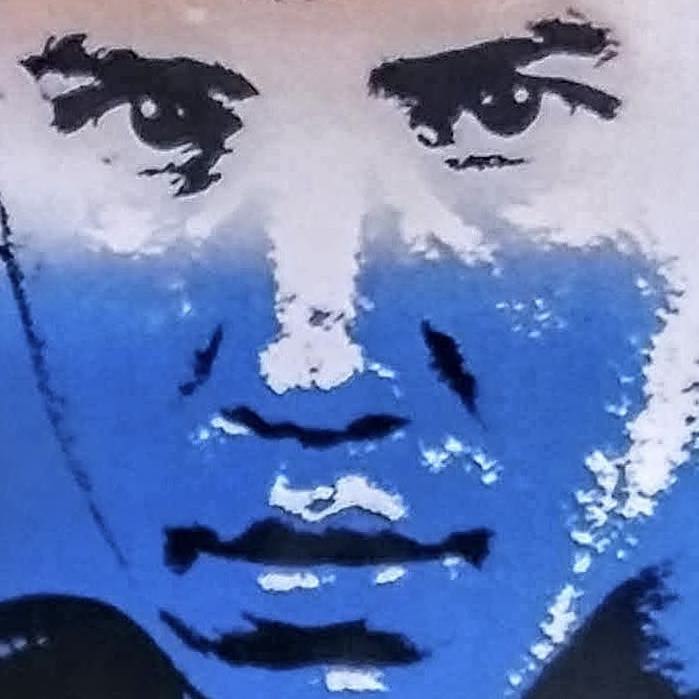
Blue-toned portrait of Tommy Morrison.
From Oklahoma boxing to a professional career
Tommy David Morrison was born in Gravette, Arkansas, on January 2, 1969, and grew up in Oklahoma. Before turning professional, he competed as an amateur and met Mercer at the 1988 United States Olympic Trials. Mercer won that contest and went on to represent the United States; Morrison entered the professional ranks later in 1988.
His left hook became the signature weapon. He could throw it quickly to the body or head and combine it with an aggressive opening attack. The resulting knockouts made him a marketable prospect, but building a championship career also required the ability to manage his output, defend under pressure and recover when an opponent survived his best punches.
Rocky V and the unbeaten rise
Morrison played Tommy Gunn opposite Sylvester Stallone in the 1990 film Rocky V. The role brought public attention before he had won a professional world title. His boxing identity and screen role became closely associated, although his actual competitive career depended on results against experienced heavyweights.
By the time of his first professional title challenge he was unbeaten in 28 fights. That record established momentum and showcased his power. It did not yet show how he would cope with a durable champion able to absorb an early attack and force him into a longer, more demanding contest.
Ray Mercer’s title defense in 1991
Morrison challenged Mercer at Atlantic City’s Convention Center on October 18, 1991. Mercer was the reigning WBO heavyweight champion, making his first defense. The belt was not vacant, and Morrison entered as the challenger.
Morrison scored effectively early and led on all three official cards after four rounds. His combinations and hooks forced Mercer to weather a sustained attack. The champion began to turn the contest in the fourth, then overwhelmed Morrison with punches against the ropes in the fifth. The referee stopped the fight 28 seconds into that round.
The result was Morrison’s first professional defeat. It revealed the difference between winning the opening exchanges and sustaining an effective fight against a strong, resilient opponent. Mercer retained his title; Morrison needed to rebuild rather than simply resume the unbeaten prospect’s trajectory.
Rebuilding through a difficult Joe Hipp fight
Morrison returned to winning form after the Mercer defeat. One important test came against Joe Hipp in Reno on June 27, 1992. Morrison sustained a broken jaw but continued and stopped Hipp in the ninth round. He had put Hipp down earlier in the fight and again in the finishing round.
That victory adds an important qualification to an account centered only on his defeats. Morrison could persist through a difficult, damaging contest and still find the finish. It did not erase the defensive and stamina questions raised by Mercer, but it showed that his competitive ability extended beyond quick victories over overmatched opposition.
George Foreman and the vacant WBO championship
On June 7, 1993, Morrison faced Foreman at the Thomas & Mack Center in Las Vegas. This time the WBO championship was vacant, following Michael Moorer’s departure from that title. Foreman’s earlier undisputed championship and later WBA/IBF reign were separate from the belt being contested that night.
Morrison did not try to settle the fight through a stationary exchange of power punches. He used movement, selected his attacks and made Foreman follow him. The older fighter remained dangerous, but Morrison avoided giving him the sustained close-range contest that could have favored his strength.
After twelve rounds Morrison won a unanimous decision. The official scores were 117–110, 118–109 and 117–110. Foreman had also lost a point for a low blow in the tenth. The victory made Morrison WBO heavyweight champion and remains the clearest example of his ability to execute a disciplined tactical plan over a full championship distance.
Tim Tomashek and the sudden loss to Michael Bentt
Morrison’s next fight came at Kemper Arena in Kansas City on August 30, 1993. Scheduled opponent Mike Williams did not go through with the contest, and Tim Tomashek became the late replacement. Morrison won when Tomashek did not continue after the fourth round. This fight belongs between the Foreman victory and the loss to Bentt in the chronology.
On October 29, 1993, Morrison defended the WBO championship against Bentt in Tulsa. He attacked strongly at the start but was caught as Bentt answered. Bentt dropped him three times, and the contest was stopped after only 1 minute 33 seconds of the first round.
Morrison’s title reign therefore ran from June 7 to October 29, 1993. The defeat also disrupted plans for a lucrative meeting with Lewis. The speed of the ending showed the danger of becoming exposed while trying to finish an opponent: Morrison’s attacking power could not compensate once he was badly hurt and unable to recover.
Ruddock, the IBC belt and the Lewis defeat
After the Bentt loss, Morrison continued fighting and was held to a ten-round draw by Ross Puritty in July 1994. His strongest subsequent victory came against Ruddock at Kansas City’s Municipal Auditorium on June 10, 1995.
Ruddock knocked Morrison down in the first round, but Morrison recovered and remained dangerous. In the sixth he dropped Ruddock with a left hook and forced the stoppage. The victory earned the vacant International Boxing Council heavyweight belt. That IBC championship was separate from the WBO title Morrison had held in 1993.
Morrison finally met Lewis in Atlantic City on October 7, 1995. Lewis controlled the contest and knocked him down four times before the referee stopped it in the sixth round. Morrison lost the IBC belt; this was not another WBO championship fight.
The two 1995 results show the range of Morrison’s late competitive position. He could still recover from danger and stop a powerful contender such as Ruddock. Against Lewis, however, he could not overcome the opponent’s reach, jab and more controlled attack.
The 1996 suspension and later appearances
In February 1996, Morrison’s scheduled Las Vegas fight against Arthur Weathers was canceled after a positive HIV test and action by the Nevada State Athletic Commission. That event brought an abrupt end to his sustained involvement at the top level of professional boxing.
Morrison later disputed the diagnosis and made intermittent returns to competition. Those later claims should not be confused with a verified reversal of the original result. His professional record includes a fight in Japan in 1996 and further appearances in 2007 and 2008, so describing his boxing career as ending completely in 1996 would also be inaccurate.
He died in Omaha, Nebraska, on September 1, 2013, aged 44. His final professional boxing record was 48 wins, three defeats and one draw, with 42 knockout victories.
Power, discipline and a brief championship legacy
Morrison’s place in heavyweight history rests most securely on the Foreman victory, the Ruddock comeback and the exceptional danger of his left hook. His best performances were not all alike: he won a championship through movement and points, then later recovered from a knockdown to beat another major puncher.
His defeats remain essential to that assessment. Mercer exposed the cost of an unsustainable early attack, Bentt ended his title reign in one round, and Lewis controlled their long-awaited meeting. Together, those results describe a capable, exciting heavyweight whose championship success was real but brief.