George Foreman built two remarkably different championship careers. The young Olympic gold medallist overwhelmed Joe Frazier to become undisputed heavyweight champion in 1973. More than twenty years later, the former champion returned as a heavier, more patient fighter and knocked out Michael Moorer to win the WBA and IBF titles at 45. His story encompasses devastating power, difficult defeats, a decade away from competition and one of boxing’s most consequential comebacks.
Foreman’s first reign ran from 1973 to 1974. His second began in 1994, with the sanctioning-body belts ending in 1995 and his lineal championship continuing until 1997. Those distinctions matter: he regained the heavyweight championship against Moorer, but did not become undisputed champion for a second time.
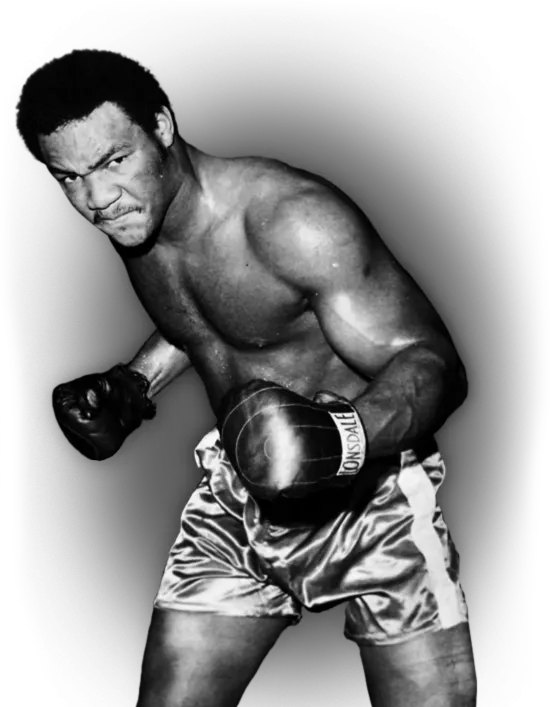
George Foreman in a fighting pose during his first professional career.
From Houston to Olympic gold
George Edward Foreman was born in Marshall, Texas, on January 10, 1949, and grew up in Houston’s Fifth Ward. The Job Corps gave him a route away from a troubled adolescence. In California, counselor and boxing coach Charles “Doc” Broadus introduced him to the sport and helped turn his physical strength into an athletic purpose.
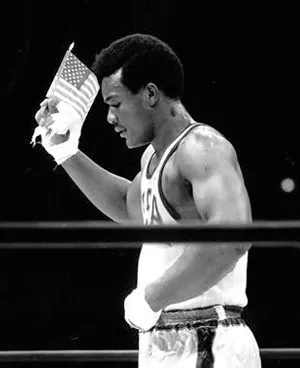
Foreman progressed rapidly enough to represent the United States at the 1968 Mexico City Olympics. He stopped the Soviet Union’s Jonas Čepulis in the heavyweight final and celebrated by carrying a small American flag around the ring. The gold medal gave a comparatively inexperienced boxer an international platform before he entered the professional ranks.
Foreman celebrated his 1968 Olympic heavyweight gold medal with an American flag.
The rise of a destructive heavyweight
Foreman turned professional in 1969. Victories over experienced opposition, including George Chuvalo, helped establish him as more than an imposing prospect. His reach, heavy jab and ability to drive an opponent backward created openings for hooks and uppercuts. Fighters who stood directly in front of him could find themselves dealing with power before they had settled into the contest.
By the end of 1972 he was unbeaten in 37 professional fights, with 35 knockouts. The challenge ahead was Frazier, a champion whose pressure and left hook had already beaten Muhammad Ali. Foreman had accumulated the record to earn the opportunity; he still had to show that his strength could overcome the best heavyweight in the world.
Foreman’s early career combined an imposing jab with exceptional finishing power.
Frazier, Norton and the first championship reign
On January 22, 1973, in Kingston, Jamaica, Foreman defeated Frazier by a second-round stoppage. He knocked the champion down six times, three in each round, and won the WBA and WBC championships. The decisive result made Foreman the undisputed heavyweight champion and transformed the division’s balance of power.
He made two successful defenses. José Roman was knocked out in the first round, and Ken Norton was stopped in the second. Norton had demonstrated his quality against Ali, yet could not withstand Foreman’s attack. The short defenses reinforced the expectation that a challenger would have to avoid prolonged exchanges rather than try to match the champion’s strength.
Muhammad Ali and the Rumble in the Jungle
Foreman faced Muhammad Ali in Kinshasa, Zaire, now the Democratic Republic of the Congo, on October 30, 1974. The “Rumble in the Jungle” offered him a chance to defeat the division’s most famous former champion. Instead, it exposed the danger of trying to force an early finish against an opponent with extraordinary defensive judgment and composure.
Ali spent long stretches against the ropes, blocking, rolling with punches and answering with his own straight shots. He also tied Foreman up at close range. Foreman continued pressing, but his attack became less effective as the fight progressed. In the eighth round Ali landed the combination that put him down for the count. Foreman lost his unbeaten record and both world titles.
The result should not be reduced to Ali simply absorbing every punch. His defense, counterpunching and management of the exchanges were central to the victory. Foreman’s power remained formidable, but power alone had not solved the tactical problem.
Ron Lyle, Jimmy Young and leaving boxing
Foreman’s next professional fight came against Ron Lyle in Las Vegas on January 24, 1976. Their contest became a dramatic test of recovery as well as punching strength. In the fourth round Lyle dropped Foreman, Foreman dropped Lyle, and Lyle put Foreman down again. Foreman survived and stopped Lyle in the fifth. The victory restored momentum after the Ali defeat.
He also defeated Frazier again, stopping him in the fifth round at Nassau Coliseum on June 15, 1976. But Jimmy Young outpointed Foreman over twelve rounds in Puerto Rico on March 17, 1977. Afterward Foreman described a religious experience in his dressing room and left boxing. His first professional career ended with 45 wins and two defeats.
He became an ordained minister and later established a youth and community center in Houston. This period was a substantial chapter of his life, rather than a short interval between championship attempts. For nearly ten years, professional boxing ceased to be his occupation.
Foreman’s ministry became central to his life after he left boxing in 1977.
A ten-year comeback and the Holyfield challenge
Foreman returned against Steve Zouski on March 9, 1987. Raising money for his community work was part of the motivation, but the comeback developed into a genuine pursuit of the championship. Wins over established opponents such as Gerry Cooney gave the campaign competitive substance. His broader physique and cheerful public manner differed sharply from his younger image.
Against Evander Holyfield in Atlantic City on April 19, 1991, the 42-year-old challenger lasted all twelve rounds. Holyfield won a unanimous decision and retained the undisputed championship. Foreman’s jab and strength produced difficult moments for the younger champion, but Holyfield’s combination punching and activity carried the scoring.
Foreman continued after the defeat. On June 7, 1993, Tommy Morrison beat him by unanimous decision in Las Vegas for the vacant WBO heavyweight title. Morrison used movement and selective exchanges rather than accepting a stationary contest between punchers. Another failed title attempt left Foreman needing an opportunity that suited his remaining strengths.
Michael Moorer and a world championship at 45
That opportunity arrived on November 5, 1994, at the MGM Grand in Las Vegas. Moorer had beaten Holyfield and held the WBA and IBF titles. He was ahead on all three official scorecards after nine rounds against Foreman. The older challenger was losing the rounds, but remained within range to land the punch that could change the fight.
In the tenth round Foreman knocked Moorer out with a right hand. At 45 he became the oldest boxer to win the world heavyweight championship. More than twenty years had passed since he lost his first reign to Ali. The victory was not an honorary achievement or a nostalgic exhibition: he had defeated the reigning champion in a sanctioned world-title fight.
Foreman took the WBA and IBF belts, together with lineal recognition. The WBC championship was separate, so this second reign was not undisputed. That does not diminish the achievement; it describes accurately what he won.
Foreman knocked out Moorer in the tenth round in 1994 to regain the heavyweight championship at 45.
The belts, Axel Schulz and the final fight
The WBA stripped Foreman in early 1995 after he chose not to face its leading contender, Tony Tucker. He therefore held only the IBF belt when he defended against Axel Schulz on April 22, 1995. Foreman received a controversial majority decision. He later relinquished the IBF title after a rematch was ordered.
His lineal claim continued beyond the loss of those organization belts. It ended on November 22, 1997, when Shannon Briggs received a majority decision over him in Atlantic City. The result was widely disputed, but remains the official outcome. It was Foreman’s last professional fight. He finished with 76 wins, five defeats and 68 knockout victories.
Retained knockout highlights from Foreman’s professional career.
A public life beyond the ring
Foreman became a boxing commentator, author and highly recognizable commercial personality. His association with the George Foreman Grill extended his public identity far beyond the sport. His later success depended as much on approachability and humor as the early boxing image had depended on intimidation.
Foreman’s later public career included broadcasting, books and commercial endorsements.
He entered the International Boxing Hall of Fame in 2003 and died on March 21, 2025, aged 76. His legacy rests on both versions of the fighter: the young champion who overwhelmed Frazier and Norton, and the veteran who found a different way to win against Moorer. Together, those careers make him a central figure in heavyweight history.
What makes a boxing match unforgettable? Explore the rivalries, drama, historic moments, and performances that have shaped the sport's greatest contests.
To millions of Ali fans, Foreman seemed like a menacing, Sonny Liston-esque figure—an intimidating presence who could never take the place of their hero.