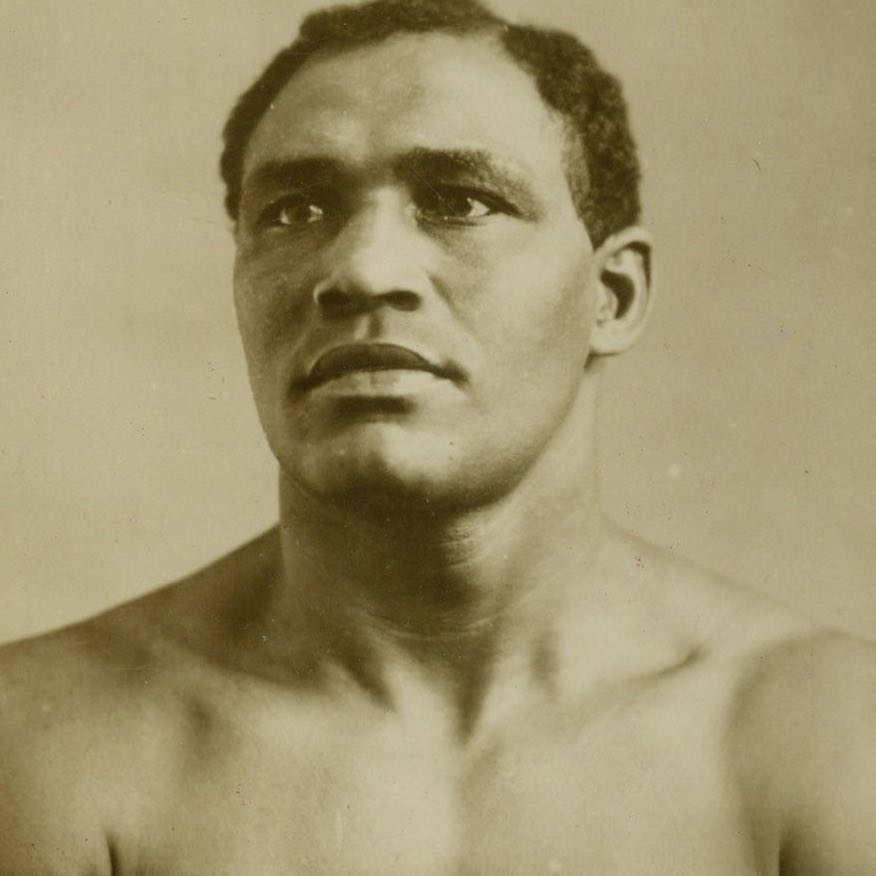
Joe Jeannette was one of the outstanding heavyweights of the early twentieth century, a New Jersey boxer whose career intertwined with Jack Johnson, Sam Langford and Sam McVey. His best-known victory came in a punishing Paris marathon against McVey, but his importance extends beyond that extraordinary contest. He belonged to a generation of Black contenders whose ability was tested repeatedly against one another while access to the recognised world heavyweight championship remained restricted.
Jeannette held the title historically called the World Colored Heavyweight Championship. That distinction deserves to be recorded in its own context: it reflected serious competition among leading fighters, but also the racial segregation of championship opportunity. It was not the same championship held by Johnson after he defeated Tommy Burns in 1908.
Joe Jeannette, the New Jersey heavyweight whose long career continued through training and work in the boxing community.
A Difficult Beginning in New Jersey
Born in New Jersey in 1879, Jeannette came to boxing through working life rather than an extensive amateur programme. He worked with his father as a blacksmith’s apprentice and later drove a coal truck. Those beginnings help explain why his development took place in professional rings, against men who were already accustomed to the trade.
Local histories describe his first ring experience in 1904 as a loss to Arthur Dickinson. Early records from this period are not perfectly consistent about which appearances belong in a formal professional ledger, so that local debut story should not be turned into a precise, unquestioned career-statistics entry.
What is clear is that Jeannette’s early setbacks did not end his ambitions. He learned through difficult matches and rematches, building the endurance and close-range skills that would become central to his reputation. His progress was measured against experienced opposition, rather than protected by a long run of carefully selected novices.
Learning Against Jack Johnson
Jack Johnson was an important part of that education. Their meetings came before Johnson became the recognised world heavyweight champion. Johnson’s defensive judgement, strength in the clinches and ability to control an opponent at close quarters presented a demanding test for a developing heavyweight.
Jeannette’s recorded victory over Johnson on November 25, 1905, in Philadelphia came by disqualification in the second round after a foul. It should not be presented as a knockout or as proof that Jeannette dominated the contest. The contemporary report described Johnson having the better of the action before the incident that ended it.
Their rivalry included other results, including a fifteen-round decision victory for Johnson in 1906. Jeannette’s significance does not depend on reducing those encounters to a simple claim of superiority. Repeated competition with Johnson helped establish him among the serious heavyweights of the period.
Sam Langford and a Demanding Rivalry
Sam Langford was another defining opponent. Their repeated contests brought together two men who could box, punch and work effectively inside. A rivalry of that length cannot be understood through a single result: different stages of their careers produced different competitive circumstances.
Jeannette scored an early stoppage victory over Langford in Lawrence, Massachusetts, in December 1905. Langford also defeated him in later meetings. Their encounters became part of the demanding circuit shared by the leading Black fighters of the era, with familiar opponents often supplying the most meaningful available competition.
Historical lists differ in how they count some meetings and classify newspaper decisions or other unofficial results. An exact rivalry total can suggest more certainty than the surviving record supports. The important point is the sustained quality of their competition, which repeatedly tested both men over substantial distances.
The Paris Marathon Against Sam McVey
On April 17, 1909, Jeannette faced McVey at the Cirque de Paris in a fight to the finish for the World Colored Heavyweight Championship. The contest became one of boxing’s most remarkable examples of endurance. McVey’s power put Jeannette in serious trouble, but Jeannette survived and gradually reversed the fight.
They completed forty-eight rounds. McVey, exhausted and badly marked around the eyes, could not continue for the forty-ninth, and Jeannette was declared the winner. The result is commonly recorded as a retirement in round forty-nine; it does not mean that a full forty-ninth round was boxed.
Accounts agree that Jeannette was knocked down repeatedly and absorbed considerable punishment. They do not agree on the celebrated exact knockdown totals that appear in later retellings. Those figures are omitted here. The verified outline is dramatic enough: Jeannette recovered from severe difficulty and outlasted a formidable opponent in a contest far longer than a modern championship fight.
A Career That Reached Beyond America
France became an important setting for Jeannette’s career. Overseas bouts gave him an audience and opportunities that were not confined to the American championship market. His success there included more than the McVey marathon.
On March 21, 1914, he defeated Georges Carpentier on points over fifteen rounds in Paris. Carpentier was a major French boxing figure and would later become world light-heavyweight champion. Jeannette’s victory belongs among his significant achievements, while its context should remain clear: it was not a victory over a reigning world heavyweight champion.
His record also intersected with the younger Harry Wills. Together, those opponents show how Jeannette’s career connected successive generations of heavyweight talent, extending beyond the one fight for which he is most often remembered.
The Segregated Championship Landscape
The colour line limited more than individual matchups. It shaped the business of heavyweight boxing: which challengers could attract backing, which matches promoters pursued and who could compete for its most valuable title. The separate championship fought over by Jeannette and his peers was a product of that landscape.
Johnson’s victory over Burns broke a major barrier, but it did not create equal championship access for Jeannette, Langford or McVey. Johnson did not defend the recognised world title against those three former rivals. That absence is part of the historical record; assigning a single private motive to every unmade fight would go beyond it.
Jeannette never became the recognised world heavyweight champion. Equally, the lack of that title should not erase the quality of the opposition he faced or imply that every contender enjoyed the same route to a championship opportunity.
Training, Officiating and a New Jersey Legacy
After his fighting career, Jeannette remained involved in boxing. His Union City gym became a place where other fighters learned their craft, including future heavyweight champion James J. Braddock. His contribution continued through training rather than ending with his last competitive appearance.
He also broke ground as an official, becoming the first African American referee and judge licensed by New York State in 1923. Away from the ring, his work included a garage and transportation business. These later roles made him a lasting figure in his local community.
Jeannette died in 1958 and was inducted into the International Boxing Hall of Fame in 1997. His legacy combines exceptional endurance, sustained competition against great opponents and the obstacles faced by Black heavyweights of his generation. Remembering all three gives a fuller account of the boxer than a disputed knockdown tally ever could.