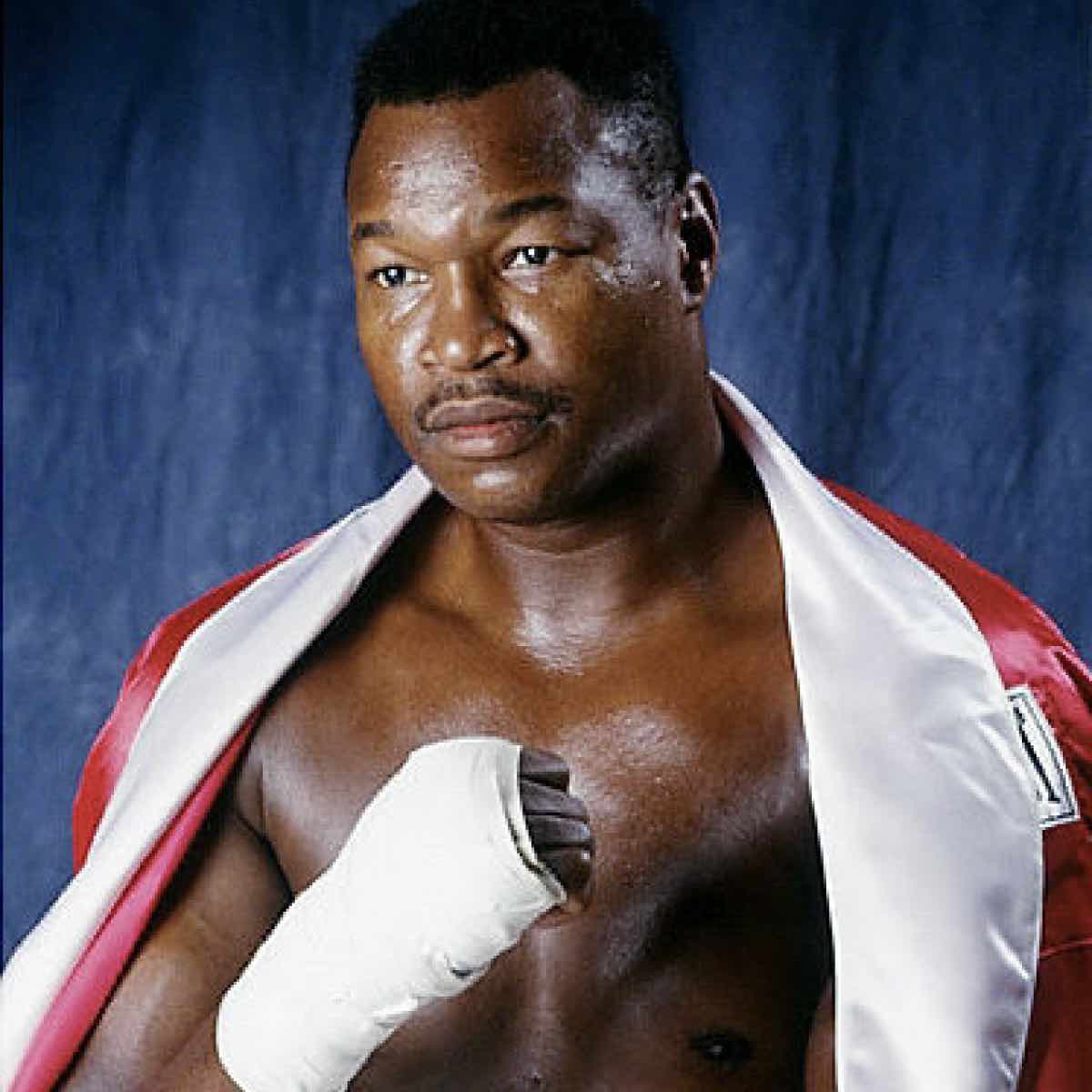
Larry Holmes ruled heavyweight boxing from 1978 to 1985 through an exceptional jab, a powerful right hand and the ability to recover when a fight turned against him. The “Easton Assassin” won the WBC title from Ken Norton, defended against leading contenders and later continued his reign under IBF recognition. His first professional defeat came against Michael Spinks after forty-eight consecutive victories.
Holmes’s career also extended well beyond his championship years. He challenged Mike Tyson after retirement, returned again to defeat Ray Mercer and competed for major titles in his forties. His final professional bout, against Eric “Butterbean” Esch in 2002, ended in a ten-round unanimous decision victory.
Larry Holmes, the Easton Assassin, whose heavyweight championship reign lasted from 1978 to 1985.
Easton, Sparring and the Professional Learning Curve
Born on November 3, 1949, in Cuthbert, Georgia, Holmes grew up in Easton, Pennsylvania. The city became central to his identity and supplied his lasting nickname. He began amateur boxing as a young adult and turned professional in 1973.
Sparring with established heavyweights was an important part of his education. Work with Muhammad Ali and other accomplished fighters exposed him to the demands of elite boxing before he held a championship himself. Those sessions supplemented the experience gained in his own competitive bouts.
Holmes’s strengths developed into a connected system. His left jab disrupted an opponent’s advance, helped measure the distance for his right hand and gave him a scoring weapon that did not require a risky exchange. He could use his reach while moving, then plant his feet and punch forcefully when an opening appeared.
The jab was central to Holmes’s control of distance and the openings for his right hand.
Ken Norton and the Championship Breakthrough
A twelve-round decision over Earnie Shavers in March 1978 put Holmes in position to challenge for the WBC title. He faced Ken Norton at Caesars Palace in Las Vegas on June 9, 1978.
Norton and Holmes fought over fifteen demanding rounds. Holmes’s jab and movement met Norton’s pressure and awkward defensive style, producing a contest in which both men had to work through exhaustion. The final round became a sustained exchange rather than a cautious wait for the scorecards.
Holmes won by split decision and became WBC heavyweight champion. This was the beginning of his long reign. The narrow result also established that the new champion could prevail in a close, physically draining contest against proven opposition.
Mike Weaver, Earnie Shavers and Championship Resilience
Holmes’s early defences included a difficult victory over Mike Weaver in 1979. Weaver made the fight competitive before Holmes stopped him in the twelfth round. The challenger would subsequently become WBA heavyweight champion, giving the result greater historical weight than an easy defence against an unknown opponent.
The September 1979 rematch with Shavers supplied an even more dramatic test. A heavy right hand sent Holmes down in the seventh round. He rose, recovered and eventually stopped Shavers in the eleventh, preserving the championship against one of the division’s most dangerous punchers.
That recovery belongs alongside his technical accomplishments. Holmes could control many fights with his jab, but his reign also required durability and composure when control disappeared. The Shavers defence remains a clear example of both.
Poster for the 4th world title defense by "The Easton Assassin" in 1979. Holmes rose from a 7th round knockdown to stop Shavers in the 11th. The bout was broadcast live on primetime TV, with three all-time greats on the undercard. pic.twitter.com/DPh41Sx9Bz
— Heavyweight History (@HVYWeightHeroes) May 11, 2023
Muhammad Ali and a Difficult Change of Generations
On October 2, 1980, Holmes defended against Muhammad Ali in Las Vegas. Ali was a former champion returning after retirement, and his reputation made the event enormous. His physical condition and diminished performance made it painful to watch.
Holmes dominated, and Ali’s corner stopped the contest after the tenth round. The result is recorded as a retirement at the end of round ten. It confirmed Holmes’s position at the top of the division, while offering little evidence about how the two would have matched up at their respective peaks.
Defences against Trevor Berbick and Leon Spinks followed in 1981. Holmes outpointed Berbick over fifteen rounds and stopped Spinks in the third. These contests formed part of a sustained championship schedule, rather than separate returns to win the title again.
Gerry Cooney and the Biggest Defence
The challenge from Gerry Cooney on June 11, 1982, became one of the most heavily promoted heavyweight fights of its period. Cooney’s destructive punching and unbeaten record made him a serious threat, while the promotion’s racial framing placed additional weight on the contest.
Holmes used his jab and right hand to make Cooney work before he could deliver his strongest shots. Cooney remained dangerous, particularly with his left hook, but the champion’s experience and more varied attack became increasingly important as the fight continued.
Holmes won by technical knockout in the thirteenth round. It was a major defence against a powerful challenger, and a performance that demonstrated the combination of technical control and toughness on which his reign rested.
World champ Larry Holmes, promoter Don King, and challenger Gerry Cooney at the Waldorf Astoria Hotel in 1981 to announce that the eagerly anticipated Holmes vs Cooney showdown is signed and sealed. Holmes would prevail by 13th round TKO. pic.twitter.com/PO10uGZuIm
Holmes’s 1982 championship defence against Gerry Cooney ended in the thirteenth round.
Tim Witherspoon and the Change from WBC to IBF
Tim Witherspoon pushed Holmes hard on May 20, 1983. The challenger’s defence, right hand and sustained effort made this one of the champion’s most difficult nights. Holmes retained the WBC title by a twelve-round split decision, a result that remains debated.
— “91 Second Massacre”(TYSONvsSPINKS) (@Tyson91seconds) January 31, 2023
Later in 1983, Holmes relinquished the WBC belt and accepted recognition as champion from the newly formed IBF. This was a change of sanctioning-body recognition during an uninterrupted championship period. It was not a second reign won through a new title-winning contest.
His IBF defences included stoppage victories over James “Bonecrusher” Smith and David Bey, followed by a fifteen-round unanimous decision over Carl Williams in May 1985. Williams’s reach and jab made that last defence particularly demanding.
Holmes made twenty successful title defences across his WBC and IBF championship years. He did not unify the major belts into an undisputed championship, but remained the division’s leading champion through a long and consequential reign.
Michael Spinks Ends the Unbeaten Run
The July 1, 1985 Sports Illustrated cover, near the end of Holmes’s unbeaten championship run.
Holmes entered his September 21, 1985, meeting with Michael Spinks with a 48–0 record. Spinks was the reigning undisputed light-heavyweight champion moving up to challenge for Holmes’s IBF heavyweight title.
Spinks won by unanimous decision over fifteen rounds, ending Holmes’s reign and denying him a forty-ninth consecutive victory. The comparison with Rocky Marciano’s 49–0 career record gave the result an additional historical dimension, but Spinks’s performance was the immediate sporting achievement.
The rematch on April 19, 1986, also went fifteen rounds. Spinks retained the title by split decision, with Holmes strongly disputing the verdict. The official result remained a Spinks victory. Holmes announced retirement in 1986, following these defeats, although earlier retirement statements and later returns make a single-date summary of his departure misleading.
The end of his championship reign in 1985 and his retirement announcements were separate events. His subsequent career was a series of returns as a former champion and contender, rather than a restoration of the title he had lost to Spinks.
Tyson, Mercer and Title Challenges in His Forties
Holmes returned to challenge Mike Tyson on January 22, 1988. Tyson stopped him in the fourth round, the only stoppage defeat of Holmes’s professional career. Holmes then spent another extended period away from competition before returning in 1991.
The most important victory of that later comeback came against unbeaten Ray Mercer on February 7, 1992. At forty-two, Holmes won a twelve-round unanimous decision through accurate scoring, defensive judgement and effective work from the ropes. The contest showed that his experience could still overcome a younger, dangerous heavyweight.
He challenged undisputed champion Evander Holyfield on June 19, 1992, and lost a twelve-round unanimous decision. Another championship opportunity came against WBC titleholder Oliver McCall on April 8, 1995. McCall retained by a close unanimous decision over twelve rounds.
These later attempts did not produce another world championship. They did demonstrate that Holmes remained capable of competing at a meaningful level long after the prime years of his reign.
Butterbean and the Completed Career
Holmes’s final professional fight took place on July 27, 2002, against Eric “Butterbean” Esch. Holmes won by unanimous decision over ten rounds.
He was fifty-two at that last appearance. His professional career had stretched from 1973 to 2002, with the championship reign occupying one continuous period from 1978 to 1985. Later comebacks added significant victories and title challenges without changing that championship chronology.
A retained documentary retrospective on Holmes’s championship career and unbeaten run.
Inducted into the International Boxing Hall of Fame in 2008, Holmes is remembered for far more than one celebrated punch. His jab, championship consistency, recovery against Shavers and successful return against Mercer all belong to an unusually complete heavyweight legacy.