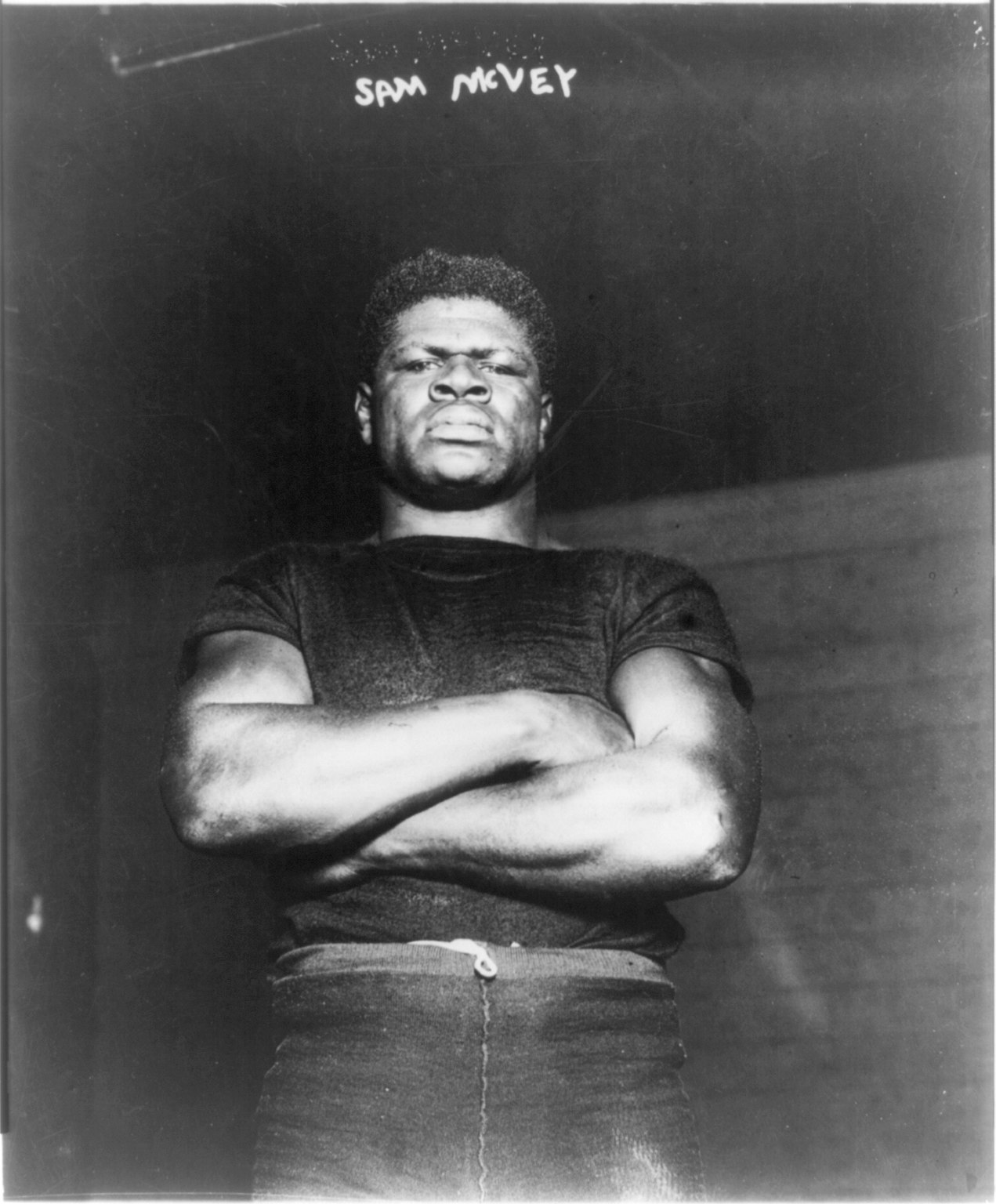
Sam McVey
Legendary Contender
Sam McVey was one of the outstanding Black heavyweights of the early twentieth century. Also recorded as Sam McVea, he fought Jack Johnson, Sam Langford, Joe Jeannette and Harry Wills while pursuing a career across several continents.
His power and durability brought him success, but they did not bring an opportunity to contest the recognised world heavyweight championship. McVey belonged to a generation whose strongest Black contenders were repeatedly matched against one another while the title remained inaccessible.
The Oxnard Cyclone
Born in Texas in 1884, McVey became closely associated with Oxnard, California, and was known as the “Oxnard Cyclone.” His exact birth date differs between official documents and his grave marker, so the year provides a firmer biographical starting point.
He began his professional career in 1902 and quickly became known for a compact, muscular build and powerful punching. That physical strength helped him compete against both taller heavyweights and accomplished opponents who had already accumulated substantial ring experience.
McVey's career developed during a period when heavyweight contests could be scheduled over distances far beyond those used today. Maintaining an attack, absorbing punishment and recovering between exchanges were essential qualities.
Three Fights with Jack Johnson
McVey met Johnson three times in 1903 and 1904, before Johnson became world heavyweight champion. Johnson won all three meetings, including a knockout in their final contest.
Those fights are distinct from a challenge for the main world title. Johnson would not defeat Tommy Burns for that championship until 1908.
McVey's losses against Johnson did not prevent him from developing an important international career. He continued facing elite opposition and became a prominent figure in a heavyweight circuit that included France and Australia as well as the United States.
The World Colored Heavyweight Championship
McVey held the World Colored Heavyweight Championship, the segregated title contested by Black fighters excluded from equal access to the main heavyweight crown.
The historical label describes the structure of boxing at the time. It should not be confused with recognition as the universally accepted world champion, but neither should the quality of its competition be dismissed.
His rivalries with Langford, Jeannette and Wills brought repeated tests against some of the era's strongest fighters. They illustrate both the depth of that competitive group and the restricted opportunities available to it.
The 1909 Joe Jeannette Marathon
McVey's most famous contest took place against Jeannette at the Cirque de Paris on April 17, 1909. It was a fight to the finish, with no ordinary scheduled points decision to settle the outcome.
McVey inflicted heavy punishment and repeatedly knocked Jeannette down, but could not secure a final stoppage. Jeannette survived and gradually gained the advantage as the fight continued.
McVey's eyes became severely swollen, and he could not continue at the beginning of the forty-ninth round. Jeannette was declared the winner.
Later accounts differ over the exact number of knockdowns. The extraordinary distance and the fighters' ordeal are established, while a precise tally should be treated cautiously. The contest demonstrates their endurance and also the extreme demands of the rules under which they fought.
Sam Langford and a Global Career
McVey faced Langford repeatedly, including during their careers in Australia. Their meetings placed his power against an opponent whose experience, timing and punching ability made him dangerous across several weight categories.
Repeated matchups could provide a living and attract spectators, but they also meant a contender might spend years fighting the same high-level rivals without progressing towards the main championship.
McVey continued competing through 1920. Published record totals vary in their treatment of newspaper verdicts, no-decision contests and other historical results, making a single unexplained figure less useful than an account of his verified opposition.
Death and Historical Recognition
McVey died of pneumonia in New York on December 23, 1921, aged thirty-seven. Johnson helped pay for his funeral and grave marker.
In 1999, McVey was inducted into the International Boxing Hall of Fame. His recognition rests on his achievements against exceptional competition and the breadth of his international career.
McVey's legacy includes more than the remarkable Jeannette fight. He was a powerful heavyweight whose career reveals how much talent existed outside the championship opportunities of his era. His place among boxing's uncrowned greats is grounded in the opponents he fought and the barriers he could not overcome.
Profile photograph: George Grantham Bain Collection, Library of Congress, 1914. No known restrictions on reproduction.

