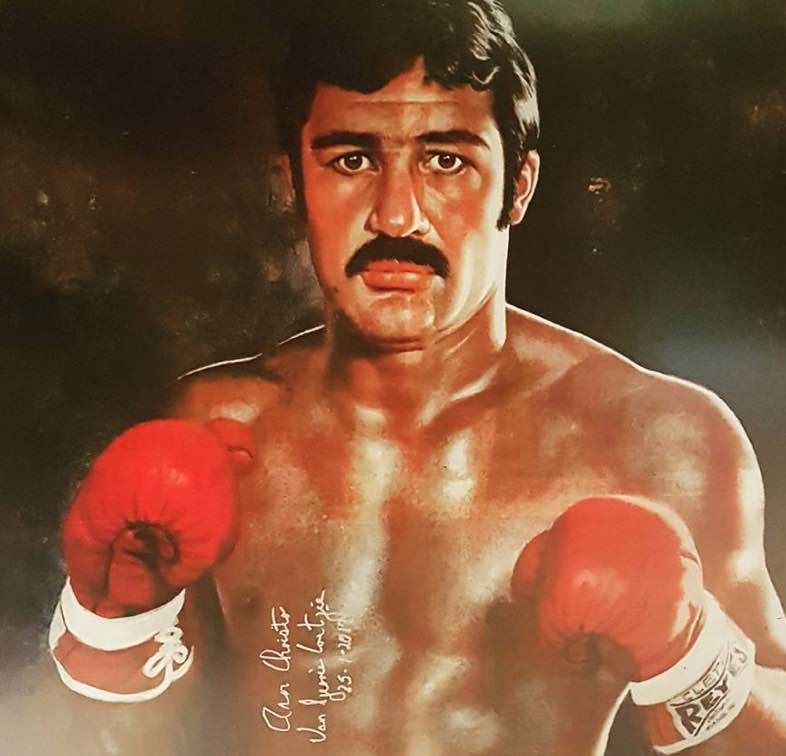
Gerrie Coetzee became Africa’s first world heavyweight champion when he knocked out Michael Dokes for the WBA title in 1983. The victory was the culmination of a difficult route through two unsuccessful championship challenges, persistent hand injuries and a division crowded with dangerous opponents. Known as the Boksburg Bomber, he brought a formidable right hand to international boxing and gave South Africa a heavyweight champion during one of the most politically charged periods in its history.
Gerrie Coetzee in red boxing gloves. His right hand was both his most dangerous weapon and a recurring source of injury.
From Boksburg to international contention
Gerhardus Christian Coetzee was born in Boksburg, South Africa, on April 8, 1955. He turned professional in 1974 and built an unbeaten record before moving onto the international stage. His nickname connected him to his hometown, while his punching power gave opponents a reason to respect him well beyond South Africa.
His career developed under apartheid, when South African sport faced international boycotts and restrictions. That setting matters to his story: opportunities abroad and recognition by the major boxing organizations were shaped by politics as well as results. It does not change the quality of the opponents he eventually faced, but it helps explain why his breakthrough carried significance beyond a championship belt.
The first-round victory over Leon Spinks
On June 24, 1979, Coetzee stopped Leon Spinks in the first round in Monaco. Spinks had taken the world championship from Muhammad Ali the previous year before losing their rematch. Beating such a recognizable former champion immediately established Coetzee as a serious contender.
The result also showed the danger of judging him solely as a local attraction. Coetzee could end a fight against an established name with explosive power. His unbeaten run now led to a much larger test: a vacant world title over fifteen rounds.
Championship setbacks against John Tate and Mike Weaver
Coetzee met John Tate for the vacant WBA heavyweight championship at Loftus Versfeld Stadium in Pretoria on October 20, 1979. The title had become available after Ali’s retirement. Tate won a unanimous decision over fifteen rounds, handing Coetzee his first professional defeat.
A second opportunity came against Mike Weaver at Sun City on October 25, 1980. Coetzee had success early and hurt Weaver with his right hand, but the American survived the pressure and became stronger as the fight progressed. Weaver knocked him out in the thirteenth round.
These were different kinds of defeats. Tate showed that Coetzee could be outpointed across a long championship contest; Weaver showed that an opponent who survived his power could still turn the fight around late. Neither loss ended his contention, but both made his eventual title victory more than a simple rise through an unbeaten record.
A fight-program cover featuring Mike Weaver and Gerrie Coetzee. Their WBA championship bout took place on October 25, 1980.
Hand injuries and the draw with Pinklon Thomas
Repeated problems with his right hand interrupted Coetzee’s training and career. Corrective operations brought the nickname “The Bionic Hand,” but the underlying story was one of recurring damage, rather than a weapon enhanced by surgery. The punch that made him dangerous also made sustained preparation difficult.
On January 22, 1983, he fought Pinklon Thomas to a ten-round draw in Atlantic City. Coetzee did well in the earlier rounds; Thomas finished strongly and opened a cut over his left eye. Two judges scored the contest even and one favored Coetzee. Against a boxer who would become WBC champion, the result kept him firmly in the world-title picture.
Defeating Michael Dokes for the WBA title
His third championship attempt came against Michael Dokes at the Richfield Coliseum in Ohio on September 23, 1983. Dokes was favored and was defending near his hometown of Akron. Coetzee nevertheless imposed his power, dropping the champion with a right in the fifth round.
Another right sent Dokes down near the end of the tenth, and the champion was counted out. Coetzee had won the WBA heavyweight title away from home and become the first African boxer to claim a world heavyweight championship. The Ring selected the result as its 1983 Upset of the Year.
This was a major world title, though the heavyweight championship was divided among sanctioning bodies. Coetzee did not become undisputed champion. His achievement stands on its own: after losing to Tate and Weaver, he returned to defeat a reigning champion decisively.
Greg Page and the controversial end of his reign
Coetzee’s first defense was against Greg Page at Sun City on December 1, 1984. Page dropped him in the seventh round and knocked him out in the eighth. The ending became controversial because the eighth round continued beyond its scheduled three minutes.
Accounts differ over the precise elapsed time, so the disputed clock should not be reduced to an uncontested number. The official outcome is clear: the WBA upheld Page’s victory. Coetzee’s reign ended with that defeat, despite the objections surrounding the timekeeping.
Later career and heavyweight legacy
Coetzee continued fighting after losing the belt, but Frank Bruno stopped him in the first round in London in March 1986. Later returns to the ring in the 1990s did not restore his place among the leading contenders.
He died of cancer on January 12, 2023, aged 67. His legacy rests on more than the short duration of his reign. The Spinks knockout, the challenges to Tate and Weaver, the Thomas draw and the Dokes victory trace the career of a genuine world-class heavyweight. His championship also established a landmark for African boxing that survives the setbacks which followed it.
Career highlights of Gerrie Coetzee, compiled by haNZAgod.
The nationally televised contest was held amidst a demonstration outside the venue, with protesters voicing their opposition to the South African Coetzee.