Jersey Joe Walcott won the world heavyweight championship at 37, after four failed title challenges and more than twenty years as a professional. His seventh-round knockout of Ezzard Charles in 1951 was the reward for an unusually long climb. A crafty boxer with deceptive movement and dangerous counters, Walcott tested Joe Louis, split a four-fight series with Charles and nearly turned back Rocky Marciano before one of heavyweight boxing’s most famous finishes.
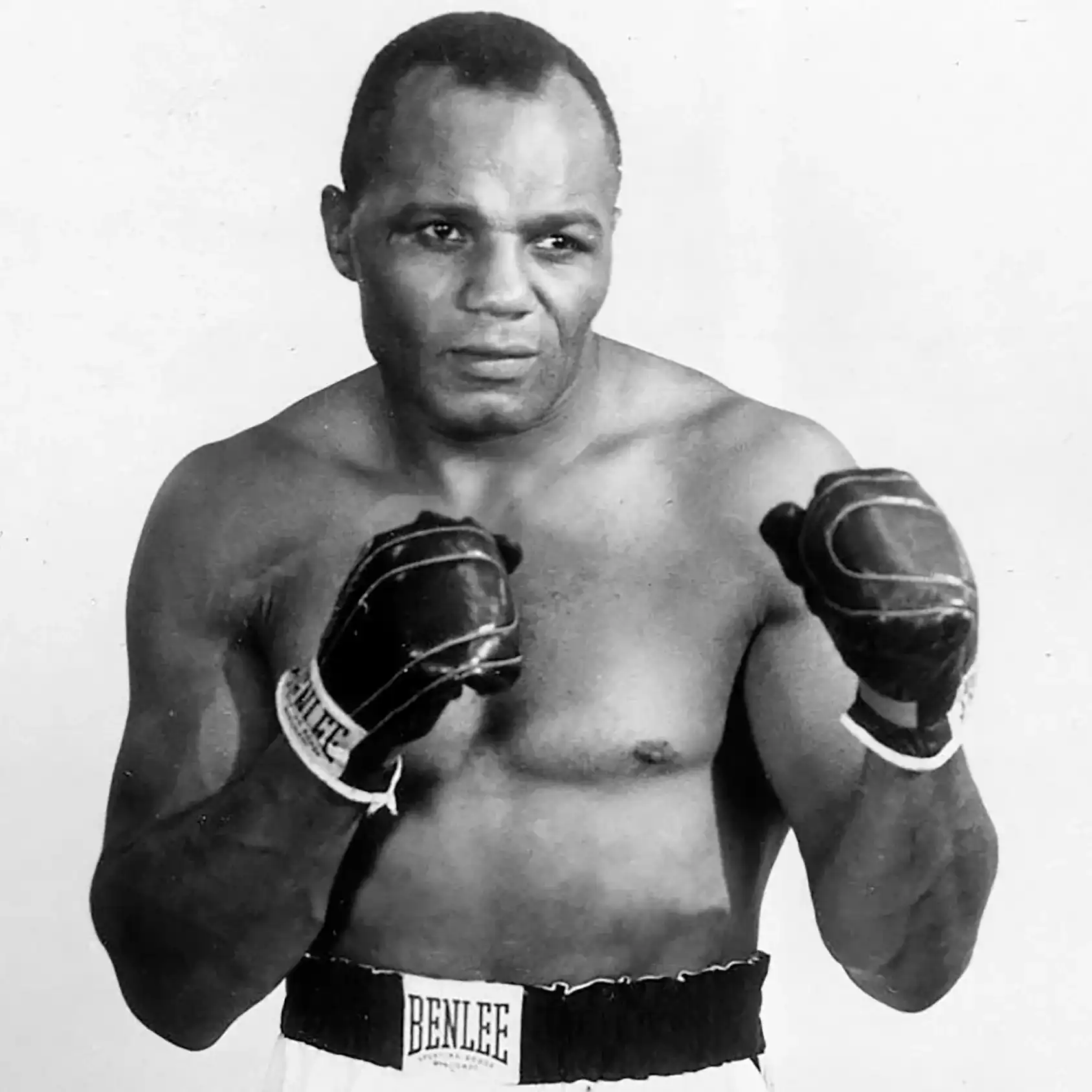
Jersey Joe Walcott in a boxing pose. Timing, feints and counterpunching were central to his success.
Arnold Cream and the long road to contention
Born Arnold Raymond Cream in New Jersey on January 31, 1914, Walcott adopted the name of Joe Walcott, the celebrated welterweight champion from Barbados, adding “Jersey” to distinguish himself. He turned professional in 1930, aged sixteen.
His career was far from an uninterrupted climb. Early defeats against leading opposition included losses to Tiger Jack Fox and a knockout by Abe Simon. Supporting his family also meant working outside boxing between contests. The future champion had to continue through circumstances that offered little assurance of a title opportunity.
By the mid-1940s, victories over established heavyweights had raised his standing. He also avenged defeats by Joey Maxim and Elmer Ray in 1947. His experience now served a style based on creating uncertainty: changing rhythm, drawing an opponent forward and countering when the opening appeared.
The disputed first fight with Joe Louis
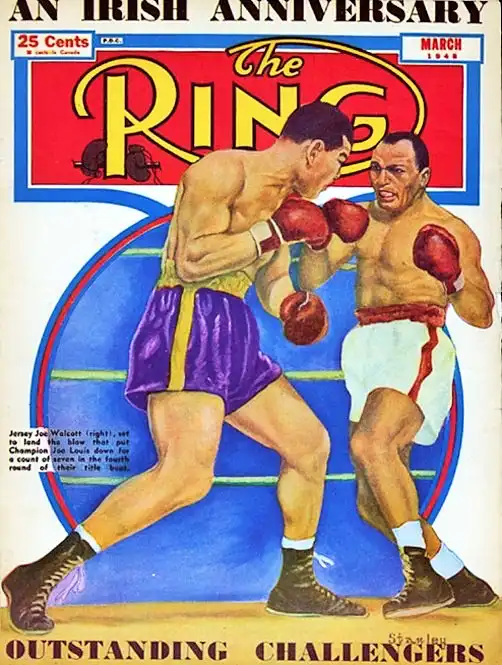
Walcott challenged Joe Louis at Madison Square Garden on December 5, 1947. Louis was the long-reigning champion and a heavy favorite, but Walcott knocked him down in both the first and fourth rounds.
After fifteen rounds, Louis retained the championship by split decision. Referee Ruby Goldstein scored for Walcott; the two judges favored Louis. Many ringside writers believed the challenger had won, and the result remains one of the era’s best-known scoring controversies.
The official decision should not be confused with unanimous contemporary approval. Equally, the controversy does not permit changing the result: Louis retained the title. What Walcott had established beyond dispute was his ability to seriously trouble the champion across a full fifteen-round contest.
An illustrated Ring magazine cover featuring Joe Louis and Jersey Joe Walcott.
Louis wins the rematch at Yankee Stadium
The rematch took place at Yankee Stadium on June 25, 1948. Walcott again put Louis down, this time in the third round. His movement and counters continued to present problems, and two official scorecards favored him before the finish.
Louis settled the contest with an eleventh-round knockout. Walcott had now lost twice to the champion, despite producing moments in both fights that suggested the title was within reach. The second result was decisive, and the first fight’s controversy cannot be used to obscure it.
Two defeats against Ezzard Charles
After Louis’s retirement, Walcott met Ezzard Charles at Chicago’s Comiskey Park on June 22, 1949, for the vacant National Boxing Association heavyweight title. Charles won a unanimous decision over fifteen rounds. Recognition of the championship was initially divided, with the NBA title not yet universally accepted.
They met again at Olympia Stadium in Detroit on March 7, 1951. Charles dropped Walcott in the ninth round and earned another unanimous decision. It was Walcott’s fourth unsuccessful championship attempt: two losses to Louis and two to Charles.
Continuing at that stage was no guarantee of eventual success. Charles had demonstrated that he could beat Walcott over the championship distance twice. Walcott’s next opportunity would require a different outcome, rather than a more sympathetic reading of the same results.
A left hook wins the world championship
On July 18, 1951, at Forbes Field in Pittsburgh, Walcott challenged Charles for the third time. He was a substantial underdog. In the seventh round, he landed the left hook that knocked Charles out and finally made him world heavyweight champion.
The finish was a striking demonstration of his counterpunching precision. After four failed title bids, Walcott had ended the fifth with a single decisive opening. At 37 he became the oldest man then to win the world heavyweight championship, a record that stood until George Foreman regained it at 45 in 1994.
The achievement belongs to a specific historical moment. Walcott was the oldest champion at that time, rather than permanently the oldest in the sport’s history. His victory also changed his rivalry with Charles from a sequence of defeats into a championship exchange.
The official program for Charles–Walcott at Forbes Field, where Walcott won the heavyweight championship on July 18, 1951.
Former heavyweight world champion Jersey Joe Walcott (real name Arnold Cream) died OTD in 1994 in his hometown of Camden, NJ at age 80. Here he is laying out Ezzard Charles and winning the heavyweight title (on his fifth try!) in 1951. VC: El Terrible Pro pic.twitter.com/IrGPfcHPO1
Walcott’s title-winning knockout of Ezzard Charles in 1951, in archival footage shared by Ringside Seat.
Defending the title against Charles
Walcott faced Charles for a fourth time at Municipal Stadium in Philadelphia on June 5, 1952. This time he won a fifteen-round unanimous decision and retained the championship.
The contest was close and drew disagreement from observers, but all three official scorers favored the champion. It was his only successful world-title defense. Their series ended with two victories each: Charles won the first two decisions, Walcott the knockout and final decision.
Defeating Charles over fifteen rounds added a different kind of validation to the championship won in Pittsburgh. Walcott had followed the spectacular finish with a successful defense against the same highly accomplished opponent.
Marciano’s thirteenth-round reversal
On September 23, 1952, Walcott defended against the unbeaten Rocky Marciano at Philadelphia’s Municipal Stadium. A left hook dropped Marciano in the opening round, the first knockdown of the challenger’s professional career.
Walcott continued to give Marciano a difficult fight and led on all three official scorecards entering round thirteen. Early in that round, near the ropes, Marciano landed a right hand that knocked him out. The title changed hands in an instant, despite the champion’s advantage on points.
The result illustrates both men’s strengths: Walcott had the skill and power to put the challenger down and build a lead; Marciano retained the ability to end a fight after twelve hard rounds. The champion’s early success made the eventual reversal all the more dramatic.
Their rematch at Chicago Stadium on May 15, 1953, ended with a first-round knockout for Marciano. Walcott protested the count, but the result stood. It was his last professional fight.
Boxing craft and a life beyond the ring
Walcott’s movement could make an opponent hesitate or follow him into a counter. He was able to combine apparent retreat with sudden offense, using feints and changes of rhythm to unsettle more direct attackers. The retained analysis below examines that timing and footwork.
An analysis of Walcott’s timing, footwork and head movement by The Modern Martial Artist.
He retired with 51 wins, 18 losses and two draws, including 32 knockout victories. His subsequent work included refereeing, serving as Camden County sheriff and heading New Jersey’s boxing commission. He was inducted into the International Boxing Hall of Fame in 1990.
Walcott died on February 25, 1994, aged 80. His championship reign was short, but his career connected three great heavyweight eras through Louis, Charles and Marciano. The late title victory remains a remarkable story of persistence, while the fights themselves establish his significance as a skilled and dangerous heavyweight.