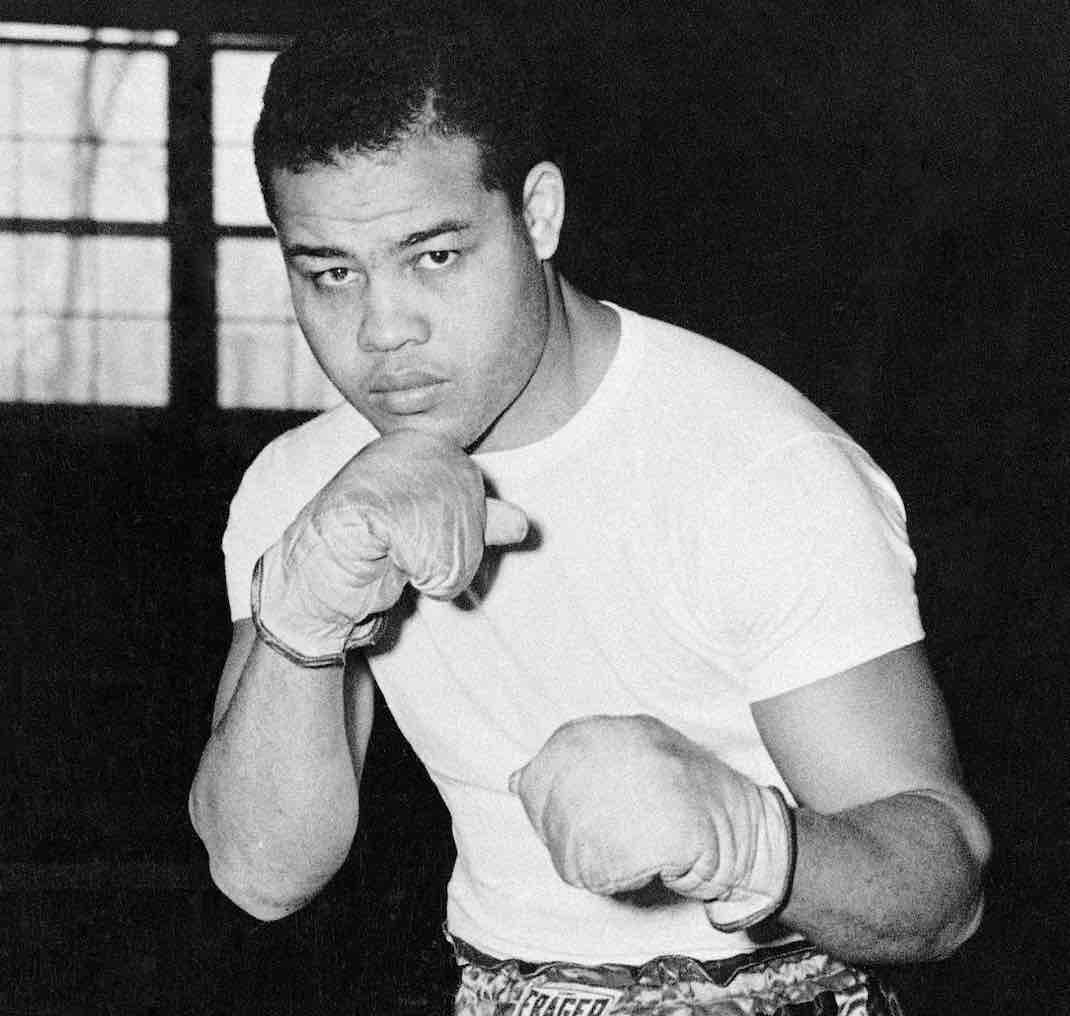
Joe Louis held the world heavyweight championship from 1937 until his retirement in 1949, completing 25 successful title defences. Known as the “Brown Bomber,” he combined precise punching, patient positioning and exceptional finishing ability. His reign became a measure against which later heavyweight champions would be judged.
Louis's importance also reached beyond boxing. A Black champion in a segregated United States, he became a source of pride and possibility for millions. His rivalry with Max Schmeling, wartime service and financial difficulties belong in that history, alongside the demanding fights that tested him throughout his championship years.
From Alabama to Detroit
Joseph Louis Barrow was born on May 13, 1914, in Alabama. His family moved to Detroit during his childhood, joining the wider movement of Black families seeking work and greater opportunity in northern cities. He took up boxing there and developed through the amateur ranks before turning professional in 1934.
Trainer Jack Blackburn helped shape a style built around balance and direct, accurately delivered punches. Louis was not a heavyweight who needed constant movement to control a fight. He advanced in small steps, kept his feet beneath him and placed himself where a short combination could have a decisive effect.
His early professional rise was rapid. Victories over former champions Primo Carnera and Max Baer in 1935 established him as a leading championship prospect. Against large or powerful opponents, he showed that compact technique could produce both control and devastating power.
The First Schmeling Fight
On June 19, 1936, at Yankee Stadium, Schmeling handed Louis his first professional defeat. The former champion repeatedly found openings for his right hand, knocked Louis down and completed a knockout in the twelfth round. It was a non-title fight: Louis had not yet won the championship.
The loss exposed a problem in Louis's defence and interrupted an apparently irresistible rise. It did not end his development. He continued winning and secured an opportunity against reigning champion James J. Braddock the following year.
That sequence is important to the rivalry. Louis did not regain a belt from Schmeling in 1938; he first had to win the championship from a different man. His return against the German boxer would be a defence of the title he earned from Braddock.
Winning the Championship from Braddock
Louis challenged Braddock in Chicago on June 22, 1937. The champion knocked him down in the first round, but Louis recovered, established his pressure and knocked Braddock out in the eighth. He became the second Black boxer to hold the recognised world heavyweight championship, following Jack Johnson.
His first defence came against Tommy Farr in August 1937. Farr gave him a durable, competitive fifteen-round test; Louis retained the title by unanimous decision. The fight is an early reminder that his reign was not a succession of effortless knockouts.
Louis's effectiveness came from putting punches together without losing his position. The jab created an opening, the right hand carried power and the left hook could finish an opponent attempting to move away. He often looked calm because he did not waste movement before committing to an attack.
The 1938 Rematch and Its Wider Meaning
Schmeling challenged Louis at Yankee Stadium on June 22, 1938. The champion attacked immediately, forcing him backward and preventing the patient counterpunching that had worked two years earlier. Three knockdowns brought the contest to an end in the first round, after two minutes and four seconds.
The rematch had been surrounded by racist Nazi propaganda and American political symbolism. Louis's victory was celebrated far beyond the ring, especially in Black American communities. The United States Holocaust Memorial Museum documents how the Nazi press had used Schmeling's earlier win to promote racial ideology; that context explains the weight placed on the rematch without reducing either boxer to a simple political caricature.
For Louis, the competitive meaning was equally clear. He had defeated the man responsible for his only loss and demonstrated that he could respond to a technical failure with a decisive adjustment. His championship authority now rested on both the Braddock victory and the emphatic Schmeling defence.
A Long Reign and the Challenge from Billy Conn
Louis defended frequently against challengers with different strengths. Some were dispatched quickly, but others forced him to solve difficult problems. The dismissive “Bum of the Month” label applied to part of his schedule should not be mistaken for an accurate description of every opponent he faced.
Billy Conn provided one of the most demanding tests on June 18, 1941, at the Polo Grounds. The smaller former light-heavyweight champion used speed, movement and combinations to build a lead on two scorecards through twelve rounds, with the third even.
Conn then pressed for a knockout. The exchanges gave Louis the opportunity he needed, and the champion stopped him in the thirteenth round. Conn's ambition mattered, but so did Louis's ability to recognise an opening and finish a skilled opponent under the pressure of a threatened championship.
Louis's reign required that capacity to recover as well as his power. He could be hurt or outboxed for periods, yet remain dangerous enough to change the result. The Conn fight is one of the clearest demonstrations of that quality.
Army Service and the Interrupted Championship Programme
Louis joined the US Army in January 1942. He donated fight earnings to military relief causes and retained the championship against Abe Simon on March 27, 1942, stopping him in the sixth round. Military service therefore did not mean he immediately ceased all boxing activity.
His regular championship programme was subsequently interrupted by the war. He travelled and boxed in exhibitions for service personnel, using his fame to support morale while serving in a segregated military. The National WWII Museum describes both that public role and the racial barriers he encountered.
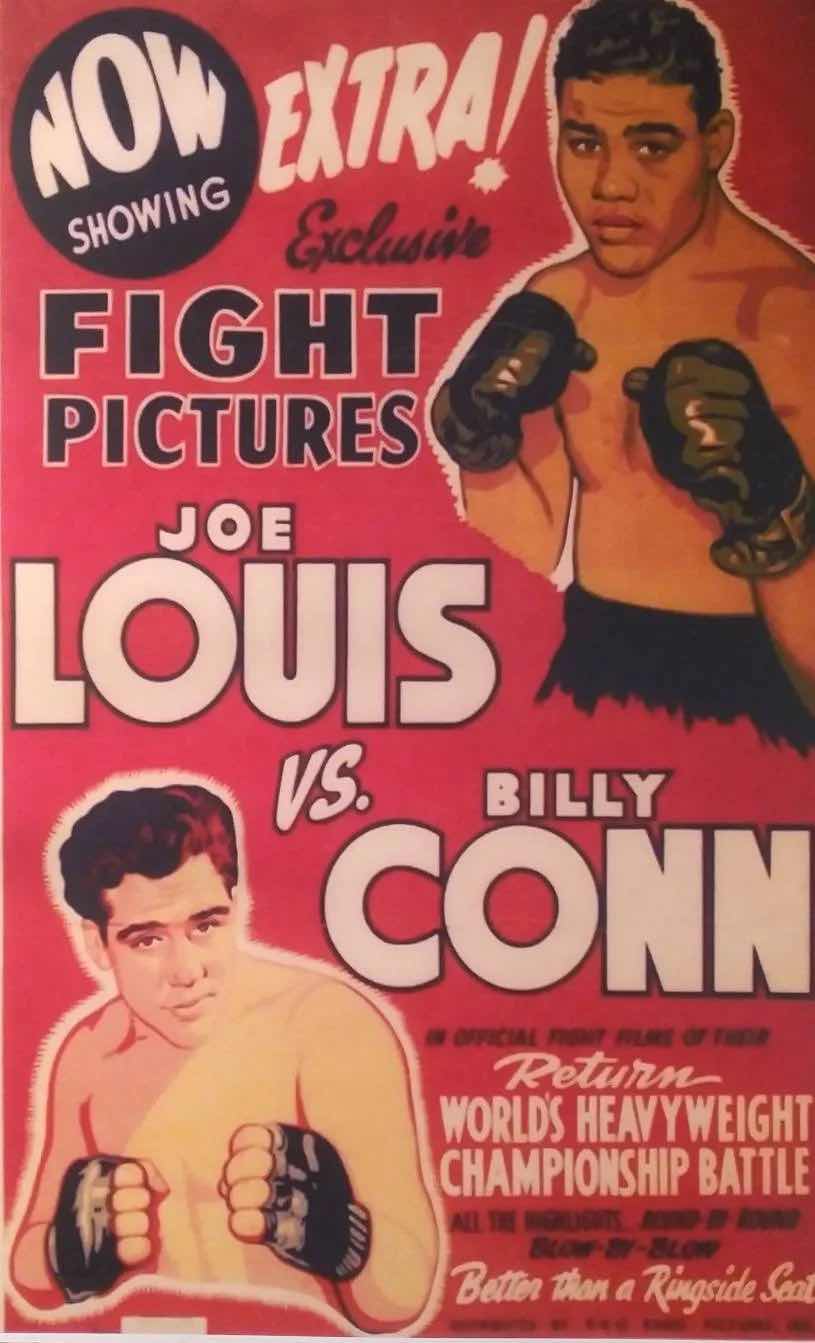
After the war, Louis resumed major championship appearances. He knocked Conn out in the eighth round of their June 19, 1946 rematch at Yankee Stadium. The return lacked the sustained suspense of their first meeting, but confirmed that the champion could still deliver a decisive finish.
A fight-film poster advertising the Louis–Conn return bout; Louis won their 1946 rematch in the eighth round.
Two Difficult Fights with Jersey Joe Walcott
Jersey Joe Walcott challenged Louis on December 5, 1947, at Madison Square Garden. Walcott's changes of rhythm, footwork and counterpunching frustrated the champion. He knocked Louis down twice, but Louis retained the title by split decision after fifteen rounds.
The verdict was controversial, with many ringside writers favouring Walcott. Reporting the official result does not require dismissing that disagreement. The fight showed a champion increasingly vulnerable to an opponent who could make him lead and then punish an opening.
Their June 25, 1948 rematch ended more conclusively. Louis recovered from another knockdown and knocked Walcott out in the eleventh round. It was his final successful defence before retirement, completing the recognised total of 25.
A period fight-film poster for Louis and Walcott, whose two championship meetings produced a disputed decision and an eleventh-round knockout.
Retirement, Charles and the Final Marciano Fight
Louis retired in March 1949 without having lost his championship in the ring. That is different from saying he had an undefeated career: Schmeling had beaten him before his reign began. His record as a defending champion remained intact when he stepped away.
Financial pressure, including substantial tax liabilities, helped bring him back. He challenged Ezzard Charles in September 1950 but lost by unanimous decision over fifteen rounds. Louis continued fighting and won several comeback contests, although he no longer controlled the division as he had during his prime.
On October 26, 1951, Rocky Marciano stopped him in the eighth round at Madison Square Garden. The contest was not for the world championship: Marciano would win that title from Walcott the following year. It was Louis's final professional fight.
Later Life and an Enduring Boxing Standard
Louis's later years included work in Las Vegas and continuing financial and health difficulties.
He died on April 12, 1981, aged 66, and was buried at Arlington National Cemetery. He entered the International Boxing Hall of Fame in its inaugural class in 1990.
Louis's achievement combines a long championship reign with victories over skilled challengers and an enduring technical influence. His economical combinations remain an example of how a heavyweight can punch hard without abandoning balance. His social significance was equally profound: the respect he earned in the ring reached a country that still denied equal treatment to many of its citizens.
From the sheer skill, power and force these athletes bring to the squared circle, heavyweight champions influence far more than the action in the ring.