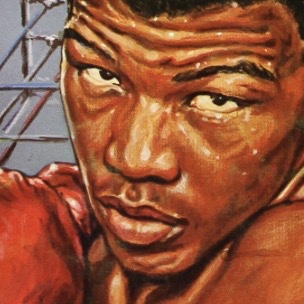
John Tate won the WBA heavyweight championship in 1979, three years after earning an Olympic bronze medal in Montreal. The large, technically capable American reached the title unbeaten, defeating Gerrie Coetzee over fifteen rounds in Pretoria, South Africa.
His reign ended in one of heavyweight boxing's most dramatic late finishes. With Tate ahead on the scorecards, Mike Weaver knocked him out in the final round of their March 1980 championship fight. Tate never regained the title and finished his professional career with a record of 34-3 (23 KOs).
From Arkansas to the Montreal Olympics
Born in Arkansas on January 29, 1955, Tate grew up in difficult economic circumstances. Boxing offered a path beyond the manual work of his early life, and his development brought him to Knoxville, Tennessee, where Ace Miller became an important figure in his career.
Tate progressed through regional amateur competition and earned a place on the outstanding United States boxing team for the 1976 Olympics. In Montreal, he reached the heavyweight semi-finals before Cuba's Teófilo Stevenson stopped him in the first round.
The defeat left Tate with a bronze medal. It was a substantial international achievement and a foundation for his professional career, even though Stevenson remained the dominant figure in Olympic heavyweight boxing.
A Rapid Professional Rise
Tate turned professional in 1977. His size did not prevent him from boxing with a useful jab and maintaining an organised approach over the distance.
Victories over Duane Bobick and Bernardo Mercado helped establish him among the rising heavyweights. In June 1979, he stopped South Africa's Kallie Knoetze in the eighth round of a title eliminator.
Muhammad Ali's retirement had left the WBA heavyweight championship vacant. Tate's victory over Knoetze brought him into a contest against Coetzee, who had defeated former champion Leon Spinks to earn the other place.
Winning the WBA Title in South Africa
On October 20, 1979, Tate faced Coetzee at Loftus Versfeld Stadium in Pretoria. He won a unanimous decision over fifteen rounds and became WBA heavyweight champion.
The event took place under apartheid, adding political significance and controversy to a sporting contest between a Black American challenger and a white South African opponent. Tate's presence drew criticism from opponents of sporting contacts with South Africa, while his victories also attracted support among Black South Africans.
In championship terms, Tate had won the WBA title rather than the undisputed crown. Larry Holmes remained WBC champion, so the division's principal championships were held by different fighters.
Mike Weaver's Final-Round Knockout
Tate's first defence took place against Weaver on March 31, 1980, at the Stokley Athletics Center in Knoxville. The champion built a lead and entered the final round ahead on all three official scorecards.
Weaver still had the power to change the result. At two minutes fifteen seconds of the fifteenth round, his left hook knocked Tate out and transferred the WBA championship.
Only forty-five seconds remained in the contest. The finish became a lasting example of why a points advantage does not make a heavyweight title secure before the final bell. For Tate, it ended both his unbeaten record and the championship reign he had won abroad.
John Tate won the vacant WBA heavyweight championship against Gerrie Coetzee in October 1979 and defended against Mike Weaver in March 1980.
Berbick and the Later Career
Less than three months later, Tate faced Trevor Berbick in Montreal. Berbick stopped him in the ninth round, leaving the former champion with consecutive knockout defeats.
Tate subsequently built another run of victories, but he did not receive another world title opportunity. Injuries and personal difficulties complicated his progress. His final contest came in 1988, when Noel Quarless defeated him on points over ten rounds.
Substance abuse, financial problems and periods in prison affected his later life. These difficulties belong in his biography without replacing the achievements of the athlete who had won an Olympic medal and a major world championship.
John Tate's Legacy
Tate died in Knoxville on April 9, 1998, aged forty-three, after a medical episode while driving led to a crash. His life ended long before many of his Olympic contemporaries had left public view.
His career is often remembered through the Weaver knockout, but the full record includes an accomplished amateur rise, an unbeaten run to contention and a decisive championship victory over Coetzee. Tate's brief reign remains a meaningful chapter in the transition from Ali's era to the divided heavyweight title picture of the early 1980s.