Michael Moorer carried a devastating light-heavyweight attack into the heavyweight division and became its first southpaw world titleholder. His 1994 victory over Evander Holyfield was the central achievement: a win over the reigning champion that brought the WBA and IBF belts and the lineal heavyweight championship. The famous defeat by George Foreman later that year belongs in his story, but it should not be allowed to become the whole story.
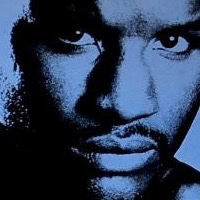
Michael Moorer in a blue-toned portrait. His championship career spanned light heavyweight and heavyweight.
Kronk foundations and light-heavyweight power
Moorer grew up in Monessen, Pennsylvania, and developed at Detroit’s Kronk Gym under Emanuel Steward. Turning professional in 1988, he quickly became known for compact, forceful punching from a southpaw stance. His early career was a demonstration of how damaging technically organised aggression could be.
He captured the inaugural WBO light-heavyweight title by stopping Ramzi Hassan in 1988. His success at 175 pounds established a genuine championship foundation before his move upward. At the same time, the WBO was a young organisation whose recognition differed from that of longer-established bodies; a careful account should identify the belt rather than imply he unified the division.
The move to heavyweight in 1991 required his skill to operate against larger men. Added weight did not remove the value of his right jab or straight left, but it changed the consequences of being caught. The new division would repeatedly test both his finishing ability and his capacity to survive an opponent’s attack.
Bert Cooper and the first heavyweight belt
On May 15, 1992, Moorer faced Bert Cooper for the vacant WBO heavyweight title in Atlantic City. Both men were knocked down during a fierce contest. Moorer had to recover from serious trouble before stopping Cooper in the fifth round.
The victory made him the first southpaw to hold a world heavyweight title. It also showed why his fights could be unpredictable: he had the skill and power to win, yet he could be hurt badly before imposing those advantages.
Winning the WBO belt was not the same as becoming the division’s universally recognised champion. That broader achievement required a meeting with the man who held the established championship lineage. Moorer would get that opportunity against Holyfield.
Outboxing Evander Holyfield in 1994
On April 22, 1994, Moorer challenged Holyfield at Caesars Palace in Las Vegas. Holyfield had regained the championship from Riddick Bowe the previous year and brought much greater heavyweight-title experience. Moorer arrived unbeaten, with Teddy Atlas in his corner.
Holyfield knocked him down late in the second round. Moorer recovered and used his right jab to disrupt the champion’s rhythm, making the southpaw stance an effective tactical tool rather than simply an unusual feature of the matchup. He could score from distance and force Holyfield to reset before launching his own attacks.
After twelve rounds, Moorer won a majority decision. The scoring was debated, including one judge’s treatment of the knockdown round, but the official result was a championship victory. He had beaten the reigning champion and taken the WBA, IBF and lineal titles. Lewis held the WBC belt, so Moorer was a unified champion rather than an undisputed one.
The Foreman defeat: a lead is not a finish
Moorer made his first defence against George Foreman at the MGM Grand in Las Vegas on November 5, 1994. Foreman was 45, and Moorer’s sharper boxing allowed him to build a lead. His jab repeatedly reached the challenger while Foreman struggled to match his speed.
In the tenth round, Foreman’s right hand ended the contest. Moorer was counted out, and the older man reclaimed the heavyweight championship two decades after losing it. The finish became one of boxing’s most replayed moments.
For Moorer, it was a devastating reversal rather than evidence that everything preceding it had been an illusion. He had been winning the fight, but a heavyweight’s advantage remains vulnerable until the contest is over. Foreman’s power exposed the risk of staying within range even when an opponent appears too slow to control the action.
Regaining the IBF title in Germany
Moorer rebuilt and faced Axel Schulz for the vacant IBF championship in Dortmund on June 22, 1996. He won a split decision over twelve rounds and returned to recognised world-title status.
That recovery matters when assessing his resilience. The Foreman defeat had ended an unbeaten run and transformed his public image, yet Moorer did not remain solely the man in the knockout footage. He won another championship through a demanding fight on his opponent’s home ground.
He defended against Frans Botha by a twelfth-round stoppage and against Vaughn Bean on points. Those victories led to a rematch with Holyfield, who had become WBA champion again by defeating Mike Tyson.
Holyfield wins the rematch
The second Holyfield fight took place in Las Vegas on November 8, 1997, with the WBA and IBF titles at stake. This time Holyfield’s combinations and pressure produced a much more decisive outcome than their first meeting.
Moorer was knocked down five times, and the contest was stopped after the eighth round. He repeatedly got up, but his willingness to continue could not reverse the damage or restore control of the fight. Holyfield added the IBF belt and avenged his earlier defeat.
The two fights together offer a better measure of Moorer than either alone. He had the boxing ability to beat an elite champion and the courage to persist under pressure. He also had vulnerabilities that a determined, technically complete opponent could exploit.
Later victories and the danger of David Tua
Moorer returned after a lengthy absence and continued competing into the 2000s. A meeting with David Tua on August 17, 2002, ended in a first-round knockout after only 30 seconds, another reminder of the division’s unforgiving power.
He nevertheless recorded further wins, including a ninth-round stoppage of former cruiserweight champion Vassiliy Jirov in December 2004. His professional career extended to 2008, and he finished with a record of 52-4-1, including 40 knockout victories.
A championship career beyond one famous defeat
Moorer was inducted into the International Boxing Hall of Fame in 2024. His place there rests on achievements across two divisions and repeated heavyweight championship success, not simply on having shared a ring with famous names.
At his best, the right jab, accurate left hand and ability to combine punches made him a difficult opponent to solve. His career also shows the narrow distance between controlling a heavyweight fight and losing it suddenly. The Holyfield victory, the Foreman reversal and the return to an IBF reign belong together: they reveal a skilled, dangerous champion whose achievements deserve the same attention as his vulnerabilities.