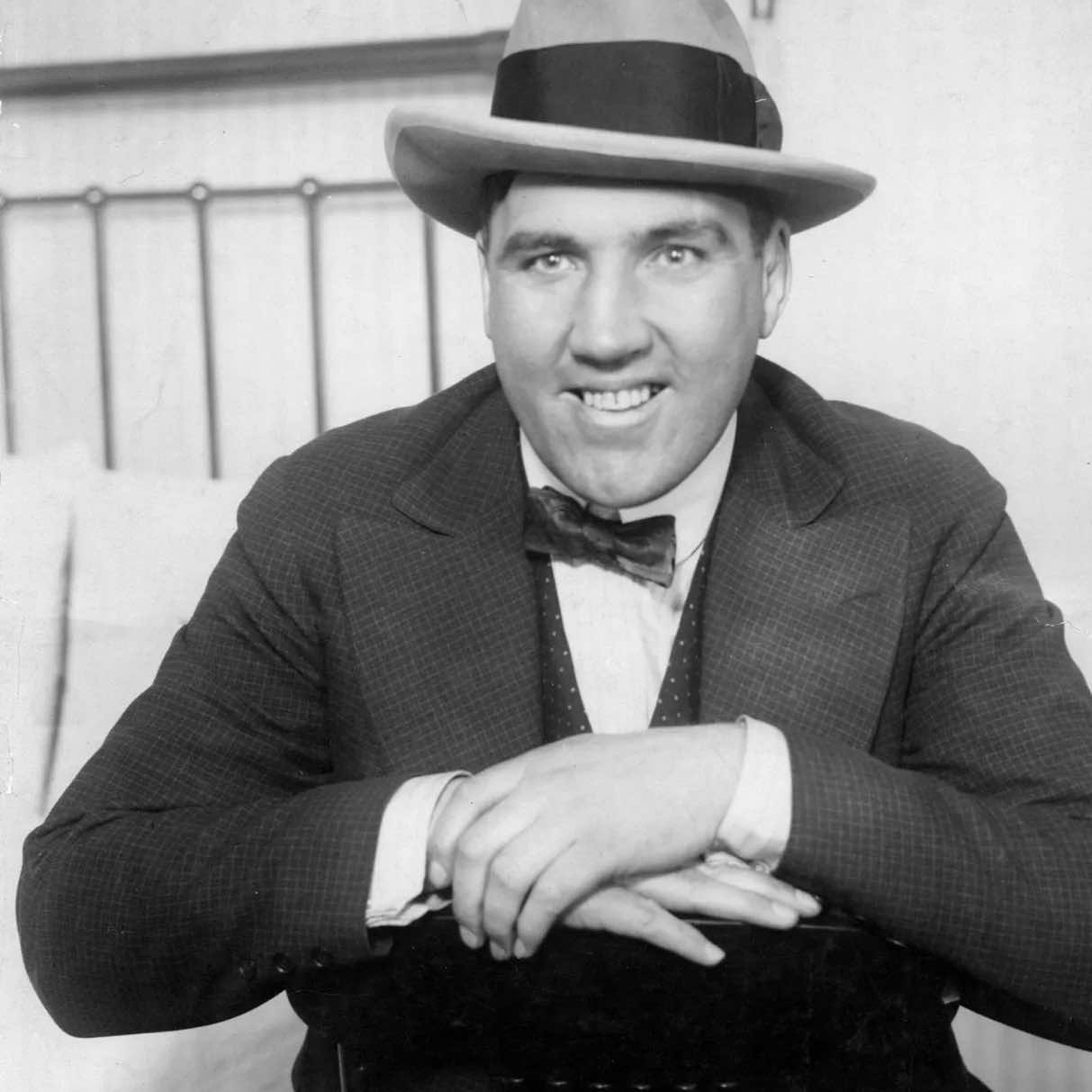
Jess Willard won the world heavyweight championship in one of boxing’s longest title fights and lost it in one of its most violent. Between those two extremes stood a Kansas heavyweight whose size, patience and endurance carried him further than his late start suggested. His knockout of Jack Johnson in Havana in 1915 ended a historic reign; his defeat by Jack Dempsey four years later announced a faster, more aggressive champion.
Profile photograph: Jess Willard seated in a suit and hat. His heavyweight championship reign lasted from 1915 to 1919.
A Kansas heavyweight with an unusual beginning
Born on December 29, 1881, in Kansas, Willard grew up in Pottawatomie County and worked with horses before becoming a professional boxer. He began his recorded professional career in 1911, already 29. There was no long apprenticeship through junior championships or an extensive amateur programme. Boxing offered a way to turn an exceptional physical advantage into a livelihood.
At roughly 6 feet 6 inches, he towered over most heavyweights of his generation. Yet height alone did not explain his success. Willard developed a useful jab, a dangerous right hand and the strength to make opponents work in close. He was most effective when a fight became a test of stamina rather than a contest of quick exchanges.
Learning against experienced opposition
Willard’s early results included setbacks as well as knockouts. His professional debut against Louis Fink ended in a disqualification loss, and contender Gunboat Smith beat him over 20 rounds in 1913. Those defeats matter: the future champion was learning his trade in public, not moving untouched through carefully chosen opposition.
His emergence also belonged to the racially charged campaign to find a white challenger who could defeat Johnson. Willard’s ability should be assessed on its own terms, but the promotion surrounding his title opportunity cannot be separated from that history.
Havana: outlasting Jack Johnson
On April 5, 1915, Willard challenged Johnson at Oriental Park in Havana, Cuba. The contest was scheduled for 45 rounds, a distance that made endurance central to the matchup. Johnson’s experience and skill gave him the better of much of the early action; Willard remained in the fight as the rounds and the heat took their toll.
In the 26th round, Willard landed the right hand that put Johnson down for the count. He had become world heavyweight champion at 33. The victory was not the work of a polished combination puncher. It was the achievement of a large, durable challenger who survived the champion’s strongest phase and was still able to finish when the opening arrived.
Historical footage of Willard’s 1915 championship victory over Jack Johnson in Havana.
The champion and the disputed accounts
Johnson later claimed that he had deliberately lost in Havana. That allegation became part of the fight’s mythology, but it should not be presented as an established explanation for the result. Willard’s knockout victory remains the recognised championship outcome.
The distinction is important when judging his career. Willard can be criticised for a limited title reign without treating the fight that won him the championship as a proven arrangement.
Frank Moran and a largely inactive reign
Willard’s only successful title defence came against Frank Moran at Madison Square Garden on March 25, 1916. They completed ten rounds under New York’s no-decision rules: the bout did not produce an official points verdict, although newspaper accounts favoured Willard. Calling it an ordinary judges’ decision would misrepresent the rules under which it took place.
Willard held the championship until July 1919 but did not build a busy record of defences. Exhibitions and public appearances formed part of his life as champion. His reign lasted more than four years; its competitive substance was much narrower than its duration.
Willard and Moran at Madison Square Garden in 1916, during a ten-round no-decision title contest.
Toledo: Jack Dempsey changes the division
On July 4, 1919, Willard defended against Dempsey in Toledo, Ohio. The 37-year-old champion weighed 245 pounds to Dempsey’s 187, but the challenger’s speed and attacking rhythm overturned that physical advantage. Dempsey knocked Willard down seven times in the first round.
Willard survived the round and fought through two more before retiring between rounds three and four. His willingness to continue was extraordinary, but it could not solve the tactical problem: Dempsey reached him too quickly and too often for the larger man to impose his preferred pace.
Separating the Toledo result from its legends
Later accounts described an extensive catalogue of broken bones and other injuries. The details are disputed and should not be repeated as settled medical findings. Allegations that Dempsey fought with loaded gloves are also contested, rather than established fact. The documented sporting outcome needs no embellishment: Dempsey’s first-round assault transformed the fight, and Willard could not continue after the third.
A comeback at 41
Willard returned to serious competition in 1923. On May 12, at Yankee Stadium, he stopped Floyd Johnson in the 11th round. At 41, the former champion had shown that his strength and resilience could still trouble a younger opponent.
The comeback ended on July 12, when Luis Ángel Firpo knocked him out in the eighth round at Boyle’s Thirty Acres in Jersey City. That was Willard’s final professional fight. Firpo subsequently challenged Dempsey, linking Willard’s last contest to the next major drama of the heavyweight championship.
Willard’s place in heavyweight history
Willard died on December 15, 1968. His lasting significance rests on more than the punishment he took in Toledo. He defeated Johnson, represented the possibilities and limitations of exceptional size, and remained part of the heavyweight story long after losing his title.
He was neither an invulnerable giant nor simply a supporting character in Dempsey’s rise. His career is best understood through the contrast between Havana and Toledo: endurance won him the championship, while speed and sustained aggression eventually took it away.