WORLD Heavyweight Boxing

Month
Date
,
Year
Legendary Contender
Gunboat Smith was a leading heavyweight contender before the reign of Jack Dempsey, with victories over Jess Willard, Sam Langford and Bombardier Billy Wells. His powerful right hand made him a serious opponent in a division shaped by long fights, racial barriers and competing championship claims. He never became the recognised world heavyweight champion, but the quality of his best wins places him well beyond the category of a colourful name from boxing’s distant past.
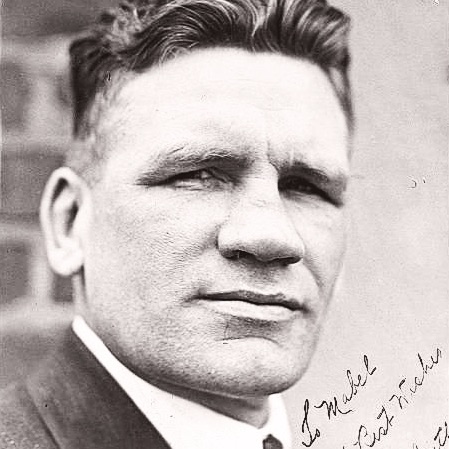
Gunboat Smith in a black-and-white portrait. His best heavyweight results came during the early 1910s.
Edward “Gunboat” Smith was born in Philadelphia in 1887. He served in the United States Navy, and a contemporary account attributed the nickname “Gunboat” to fellow sailors commenting on the size of his feet. The name suited the forceful image he later carried into the professional ring.
His career developed in a boxing world very different from the modern title system. Some contests ended with official decisions, while others were recorded as no-decision bouts and assessed by newspapers. Fighters travelled between jurisdictions with different rules and fought opponents across a wider range of weights than modern division labels might suggest.
Smith’s most distinctive weapon was his right hand. That reputation gave his opponents an immediate problem, but his important victories were not all quick knockouts. His results against Willard and Langford also required him to remain effective over a scheduled distance.
On March 14, 1913, Smith knocked out Britain’s Bombardier Billy Wells in the second round in New York. Wells was a prominent British heavyweight, and beating him strengthened Smith’s standing beyond the local American circuit.
On May 20, Smith outpointed Jess Willard over twenty rounds in California. Willard had not yet become world champion; he would take that title from Jack Johnson in 1915. Smith’s win therefore belongs to the contender stage of Willard’s career, rather than being described as a championship victory.
The combination of a fast knockout over Wells and a long-distance victory over Willard showed why Smith attracted serious attention. He could threaten a skilled opponent with power and could also win a demanding contest against a much larger man.
Smith defeated Sam Langford on points over twelve rounds in Boston on November 17, 1913. Langford was among the most accomplished fighters of the period, making the result one of the strongest names on Smith’s record.
The decision drew disagreement among observers. That controversy is part of the fight’s history, but it does not change the official result. Smith was awarded the victory; it should neither be erased nor presented as an uncontested demonstration of superiority.
Langford reversed the result in October 1914, knocking Smith out in the third round. Their two meetings provide a useful balance. Smith was capable of a major result against exceptional opposition, while Langford’s decisive return victory exposed how difficult it was to repeat that achievement.
On January 1, 1914, Smith stopped Arthur Pelkey in the fifteenth round in Daly City, California, and took the title then promoted as the “White Heavyweight Championship.” The terminology reflected the racial exclusion surrounding the search for a white challenger to Jack Johnson.
Johnson remained the recognised world heavyweight champion. Smith’s Pelkey victory did not remove him from that position, and the racially restricted title did not represent a unified or equivalent world championship.
The Pelkey fight was a substantial professional success and increased Smith’s prominence. It nevertheless belonged to the racially divided title claims of the period, while Johnson held the world championship. His strongest claim to importance lies in the opponents he beat and the challenges he posed.
Smith faced Georges Carpentier at Olympia in London on July 16, 1914. The bout ended in the sixth round when Smith was disqualified for striking Carpentier while the Frenchman was down.
Contemporary reports argued fiercely about the incident, the treatment of an earlier knockdown and the conduct of Carpentier’s corner. Some accounts considered the disqualification justified; others saw an unfair ending. The surviving record is a disqualification victory for Carpentier, not a knockout or a points decision.
The sharply divided reports left the incident open to competing interpretations. Smith lost the restricted title, but the argument over how the contest ended became part of its enduring interest.
British Pathé archive footage of Gunboat Smith.
Smith later met Jack Dempsey twice. Dempsey won a four-round decision in 1917 and knocked him out in the second round in December 1918, during the run that carried the younger fighter towards Willard’s championship.
The later result marked a clear difference between Smith’s earlier standing and the new contender’s momentum. Smith had once beaten the man Dempsey would dethrone, but a victory over a common opponent did not make their own matchup predictable.
His wider opposition included fighters such as Harry Greb and Battling Levinsky. That variety is more informative than a simple list of famous names: Smith competed in an era when accomplished men often crossed modern weight-category boundaries and repeatedly faced demanding opponents.
After his fighting career, Smith worked as a boxing referee and appeared in films during the 1920s. He died on August 6, 1974, aged 87. His long life connected an early twentieth-century fighting career with decades in which boxing’s rules, presentation and champions changed substantially.
Smith’s legacy is strongest when its achievements and limitations are kept together. He beat Willard before Willard became champion, earned an official decision over Langford and stopped Wells. He also lost important return contests and never took the recognised heavyweight crown.
His story helps explain the heavyweight division between Johnson and Dempsey: a period of formidable contenders, uneven opportunities and titles whose names require careful interpretation. Gunboat Smith was a serious participant in that history, not merely an opponent who happened to appear on the records of greater champions.

Top Heavyweight Boxing covers the past, present and future of boxing's premier division. Copyright© 2026
Powered by Digital Dynasty Design