Jack Dempsey held the world heavyweight championship from 1919 to 1926 and helped turn the title fight into a mass sporting spectacle. The “Manassa Mauler” brought fast, sustained attacks, a distinctive crouch and the threat of a sudden finish. With promoter Tex Rickard, he also drew audiences and revenues that changed boxing’s commercial ambitions.
His career has accumulated enough legends to obscure the actual contests. The victory over Jess Willard, the million-dollar Carpentier promotion, the wild Firpo defence and two defeats by Gene Tunney provide a stronger account than borrowed quotations or unsupported tales about loaded gloves. They show both the force of his prime and the limits of his championship reign.
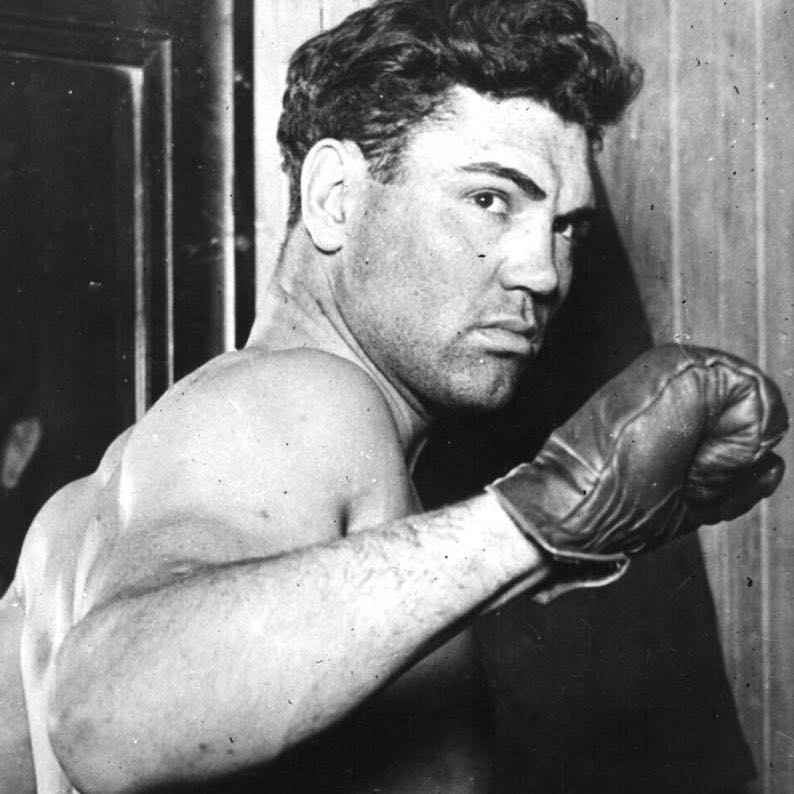
Profile photograph: Dempsey in a gloved boxing pose, showing the compact posture associated with his attacking style.
From Manassa to the heavyweight contenders
William Harrison Dempsey was born on June 24, 1895, in Manassa, Colorado. He grew up in poverty and travelled in search of work and fights as a young man. He boxed under the name Kid Blackie before establishing himself as Jack Dempsey, taking a ring name already made famous by the earlier middleweight champion Jack “Nonpareil” Dempsey.
The ascent was not an unbroken procession of victories. Jim Flynn knocked him out in the first round in 1917; Dempsey reversed that result with a first-round knockout in their 1918 rematch. Working with manager Jack Kearns, he became a serious heavyweight challenger through victories over opponents including Bill Brennan, Battling Levinsky and Gunboat Smith.
A particularly important breakthrough came against Fred Fulton on July 27, 1918. Dempsey stopped the established contender in the opening round. The performance made it increasingly difficult to overlook him when considering a challenger for Willard.
Why Dempsey’s pressure was different
Dempsey used movement to get inside a taller opponent’s reach. He bent at the knees and waist, shifted his head away from incoming punches and sought positions from which he could attack the body and head in quick succession. His left hook was a major weapon, but the threat depended on more than one punch.
His boxing was also shaped by the rules and practice of his era. A fighter could be knocked down repeatedly in a round, and enforcement of the distance between an attacker and a fallen opponent differed from what modern viewers expect. The surviving films are valuable, but those differences matter when comparing his attacks with later heavyweight boxing.
Archival highlights illustrate Dempsey’s crouching approach and close-range attacks; the compilation spans different contests.
Willard and the championship in Toledo
On July 4, 1919, Dempsey challenged Jess Willard in Toledo, Ohio. Willard weighed 245 pounds to Dempsey’s 187, but the size difference did not protect him from the challenger’s speed. Dempsey knocked him down seven times in the first round and continued to attack after Willard survived to the bell.
Willard did not come out for the fourth round. Dempsey was heavyweight champion at 24, and the one-sided finish became the foundation of his reputation. The bout is often accompanied by an elaborate list of broken bones and claims of altered hand wraps or gloves. Those disputed details should not be repeated as established fact: the visible damage and the official result need no embellishment.
Miske, Brennan and the first million-dollar gate
Dempsey’s first successful title defence came against Billy Miske in September 1920, when he won in three rounds. In December he faced Bill Brennan at Madison Square Garden and stopped him in the twelfth. Brennan made the champion work much longer than Willard had, an important reminder that Dempsey’s title fights did not all follow the same pattern.
The contest with Georges Carpentier on July 2, 1921, at Boyle’s Thirty Acres in Jersey City enlarged the scale of the business. Carpentier was the French light-heavyweight champion and a celebrated wartime figure. Rickard’s promotion produced boxing’s first million-dollar gate, while radio carried the event to people beyond the arena.
Dempsey knocked Carpentier out in the fourth round. The commercial significance outlasted the contest itself: a heavyweight championship could now be sold as a major public occasion, with the fighters’ identities and reputations reaching far beyond regular boxing followers.
Gibbons in Shelby and Firpo at the Polo Grounds
On July 4, 1923, Tommy Gibbons took Dempsey the full 15 rounds in Shelby, Montana. Dempsey retained the championship by decision. Gibbons’s resistance gave a different measure of the champion from the quick finishes that dominate highlight reels.
The next defence, against Luis Ángel Firpo at New York’s Polo Grounds on September 14, was a much more chaotic affair. Dempsey dropped Firpo seven times in the opening round, but the Argentine also put him down and then knocked him through the ropes. Ringside spectators helped Dempsey back into the ring, a controversial intervention that forms part of the fight’s history.
Dempsey recovered and knocked Firpo out in the second round. The contest delivered almost everything that made his fights compelling: rapid attacks, repeated changes in danger and a champion who could be hurt as well as hurt others. It was his fifth and final successful championship defence.
The missing Wills fight and three-year inactivity
Harry Wills was a leading Black heavyweight contender during Dempsey’s reign, but never received a championship fight with him. Negotiations and proposed promotions did not produce a contest. Accounts differ over how responsibility should be assigned among Dempsey, his representatives, promoters and authorities; the sport’s racial barriers are essential to understanding the outcome.
What is beyond dispute is the gap in the championship record. Dempsey never tested himself against Wills for the title. His reputation should be assessed with that omission in view, rather than treating a fight that never happened as an imagined victory.
After the Firpo defence in September 1923, Dempsey went three years without a competitive title fight. Exhibitions and entertainment work kept him visible, but did not provide the same preparation as championship opposition. When he returned, Gene Tunney presented a very different problem.
Tunney takes the title in Philadelphia
Dempsey lost the championship to Gene Tunney on September 23, 1926, in Philadelphia. Tunney used movement, straight punches and disciplined distance to deny the champion the sustained close-range exchanges he wanted. He won a unanimous decision over ten rounds.
The defeat was more than an interruption of Dempsey’s popularity. Tunney demonstrated that a heavyweight could manage the pressure through organisation and accurate boxing. Dempsey’s long absence is relevant, but the result also belongs to the challenger who prepared for and solved the task in front of him.
Sharkey and the disputed Long Count rematch
Dempsey earned another attempt by knocking out Jack Sharkey in the seventh round at Yankee Stadium on July 21, 1927. The finish was controversial: Sharkey turned to complain about low blows and Dempsey landed the decisive left hook. The official victory led to the second Tunney fight.
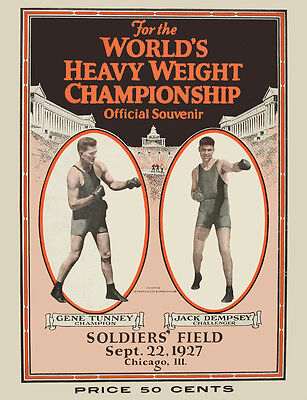
The 1927 rematch programme. The seventh-round knockdown made this contest famous as the “Long Count” fight.
On September 22, 1927, they met at Soldier Field in Chicago. Dempsey’s seventh-round combination knocked Tunney down, but he did not immediately comply with the instruction to move to a neutral corner. Referee Dave Barry delayed the count until he did. Tunney rose before the referee reached ten, resumed boxing and retained the championship by another unanimous ten-round decision.
The extra time on the canvas created an enduring argument. It does not establish that Tunney would necessarily have failed to rise under a different count: a boxer responds to the referee’s count, not an independent stopwatch. The delay and its cause can be described confidently; the alternative result cannot.
This was Dempsey’s final competitive professional fight. He had produced a dangerous moment, but Tunney again won the contest as a whole. The rematch left Dempsey without the title and with a place in one of boxing’s most debated episodes.
The champion’s long life beyond the ring
Dempsey remained a familiar public figure after retirement, including through his New York restaurant. During the Second World War he served in the US Coast Guard, helping train personnel in physical fitness. He died in New York on May 31, 1983, aged 87, and was inducted into the International Boxing Hall of Fame in 1990.
His influence reaches beyond a list of victories. Dempsey showed how an aggressive heavyweight could combine footwork, head movement and compact punches, while his biggest promotions helped create the modern scale of the championship event. Later fighters, including Mike Tyson, drew interest toward the same tradition of explosive pressure.
His legacy is strongest when it includes the whole record: five successful title defences, long periods without a championship contest, the unmade Wills fight and Tunney’s two victories. Dempsey was an extraordinary attacking fighter and a central figure in boxing’s growth, with a career more instructive than the mythology surrounding it.