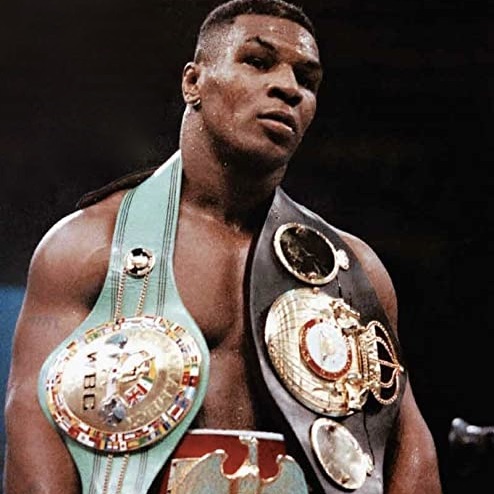
Mike Tyson made heavyweight boxing feel urgent. His speed, compact combinations and aggressive defence carried him to a world title at 20 and to the WBC, WBA and IBF championships before his 22nd birthday. For opponents, the danger was not simply a heavy punch: it was how quickly he could get close enough to land several.
That extraordinary rise was followed by defeat, imprisonment and a second championship run that ended against Evander Holyfield. Tyson’s place in boxing history rests on both sides of the story: the skill and achievement of his prime, and the failures that prevent his career from being reduced to a celebration of power.
Profile photograph: Tyson with heavyweight championship belts, a visual reminder of the titles he brought together in 1987.
Brooklyn beginnings and the Catskill gym
Michael Gerard Tyson was born in Brooklyn, New York, on June 30, 1966. Boxing became a route out of a troubled adolescence when Bobby Stewart, a counsellor at the Tryon School for Boys, introduced him to Cus D’Amato. At D’Amato’s gym in Catskill, Tyson found a demanding boxing education and a mentor who believed he could become heavyweight champion.
D’Amato’s system emphasised a high guard, movement of the head and feet, and attacks built around changing angles. Tyson learned to slip a jab, close the distance and punch to the body before coming back upstairs. His shorter stature made that movement essential against taller heavyweights. He could be explosive because he had learned how to create an opening, rather than waiting for one.
Tyson won Junior Olympic titles in 1981 and 1982 and the national Golden Gloves heavyweight championship in 1984. He did not make the US Olympic team: Henry Tillman defeated him in both the 1984 trials and the subsequent box-offs. His next step was professional boxing.
Tyson and D’Amato: the Catskill relationship behind his early boxing development.
A professional rise measured in months
Tyson made his professional debut on March 6, 1985, stopping Hector Mercedes in the first round in Albany, New York. He was 18. An unusually busy schedule gave him repeated opportunities to turn gym lessons into competitive experience, and his early stoppages quickly attracted attention.
D’Amato died in November 1985, before Tyson won a world title. Kevin Rooney remained central to his training during the championship ascent. As the opposition improved, Tyson showed that his game could last beyond an early knockout: his attacks were supported by balance, quick recoveries into position and a willingness to work behind the jab.
Berbick and the youngest heavyweight champion
On November 22, 1986, Tyson stopped Trevor Berbick in the second round in Las Vegas to win the WBC heavyweight title. At 20 years and four months, he became the youngest boxer to win a recognised world heavyweight championship, surpassing the age record of Floyd Patterson.
The finish became one of the defining images of his career. Berbick tried repeatedly to regain his footing after the decisive knockdown, but could not recover his balance. Tyson had reached the objective D’Amato had set for him; the next challenge was to bring the division’s titles together.
Tyson’s second-round stoppage of Berbick on November 22, 1986, secured the WBC title.
Smith, Tucker and the 91-second Spinks finish
Tyson added the WBA belt with a unanimous decision over James “Bonecrusher” Smith on March 7, 1987. On August 1, he beat Tony Tucker by another unanimous decision to collect the IBF championship. Both fights lasted 12 rounds. They matter alongside the spectacular knockouts because Tyson had to keep winning when opponents denied him a quick finish.
Holding all three belts made him the first heavyweight to unite the WBC, WBA and IBF titles. The remaining question concerned Michael Spinks, who retained the lineal claim after his victories over Larry Holmes. Tyson settled that argument in Atlantic City on June 27, 1988, knocking Spinks out in 91 seconds.
Earlier that year he had stopped Holmes in the fourth round and Tony Tubbs in the second. The Spinks victory brought the championship claims together and represented the clearest expression of Tyson’s dominance: a major contest ended almost as soon as it began.
Douglas breaks the unbeaten run
On February 11, 1990, James “Buster” Douglas defeated Tyson at the Tokyo Dome. Douglas used his reach, jab and combinations to keep the champion occupied at a distance where Tyson was less effective. Tyson still dropped him with an uppercut in the eighth round, but Douglas recovered and knocked Tyson out in the tenth.
The upset is often explained only through Tyson’s preparation or the controversy over the eighth-round count. That overlooks Douglas’s performance. He repeatedly interrupted Tyson’s approach and continued attacking after the knockdown. The belts changed hands because Douglas produced the better fight that night.
ESPN archive footage of Douglas’s tenth-round knockout of Tyson in Tokyo, February 11, 1990.
Ruddock, conviction and the interrupted career
Tyson rebuilt his position with wins, including two demanding contests against Donovan “Razor” Ruddock in 1991. He stopped Ruddock in the seventh round of their first meeting and won their rematch by unanimous decision over 12 rounds. The second fight showed a contender still capable of succeeding through a hard, extended contest.
On February 10, 1992, an Indiana jury convicted Tyson of raping Desiree Washington. He received a six-year prison sentence and was released on March 25, 1995, after serving approximately three years. The conviction is an essential part of his biography and must not be treated as merely an obstacle on the way to a sporting comeback.
The second title run and Holyfield defeats
Tyson returned against Peter McNeeley on August 19, 1995. The official result was a first-round disqualification win after McNeeley’s corner entered the ring, not a knockout. In 1996 Tyson regained the WBC title by stopping Frank Bruno in three rounds, then won the WBA belt with a first-round stoppage of Bruce Seldon.
Evander Holyfield ended that renewed title run on November 9, 1996, stopping Tyson in the eleventh round. Holyfield met the pressure with physical strength, accurate counters and disciplined work at close range. In their June 28, 1997 rematch, Tyson was disqualified in the third round after biting Holyfield’s ears. The incident led to the revocation of his Nevada boxing licence and overshadowed the attempted revenge.
Lewis, retirement and the later appearances
Tyson challenged Lennox Lewis in Memphis on June 8, 2002. Lewis controlled the distance and knocked him out in the eighth round. Further defeats followed against Danny Williams in 2004 and Kevin McBride in 2005. Against McBride, Tyson did not come out for the seventh round and announced his retirement.
His 2020 appearance against Roy Jones Jr. was an exhibition and did not alter his professional record. The eight-round contest against Jake Paul in Arlington, Texas, on November 15, 2024, was sanctioned as a professional fight. Tyson, then 58, lost by unanimous decision. After that bout his record stood at 50 wins, seven defeats and two no contests, with 44 knockout wins.
What Tyson’s boxing legacy rests on
Tyson entered the International Boxing Hall of Fame in 2011. His strongest claim to greatness comes from the championship ascent and the 1987–88 peak, when speed, defensive movement and combinations worked together. Watching only the final punch misses much of what made him effective.
His later career also sets limits on the mythology. Douglas, Holyfield and Lewis each found ways to withstand or disrupt his attacks. Tyson remains a central figure in heavyweight history because his prime changed the expectations placed on a young champion—and because the rest of his career shows how difficult that level is to sustain.
From George Foreman and Tyson Fury to Ricky Hatton, explore the personal struggles, second chances and support behind some of boxing’s best-known names.
In the end, the path to undisputed greatness is fraught with challenges and obstacles, but for those who dare to dream, the rewards are beyond measure.
From the sheer skill, power and force these athletes bring to the squared circle, heavyweight champions influence far more than the action in the ring.