Oleg Maskaev won the WBC heavyweight championship in 2006 by stopping Hasim Rahman in the final round. It was his second victory over Rahman, following a spectacular knockout in 1999, and the culmination of a career that had already survived several damaging defeats. His reign included a successful defence against Peter Okhello before Samuel Peter took the title in 2008.
Maskaev’s story is defined by the threat of his right hand and the difficulty of keeping himself in contention after stoppage losses. He was not an unbeaten prospect carried directly into a championship. He reached the belt after rebuilding a career that had repeatedly appeared to lose its momentum.
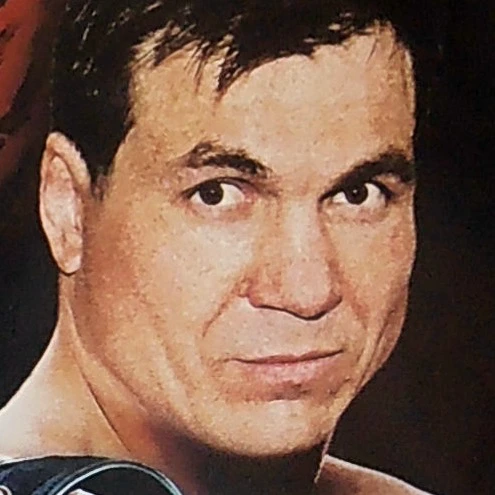
Oleg Maskaev, the former WBC heavyweight champion known as the Big O.
A Soviet Amateur Background
Maskaev was born on March 2, 1969, in Abay, Kazakhstan, then part of the Soviet Union. His boxing development began in the Soviet amateur system, where he competed in military competition before entering the professional ranks.
That background included a 1991 military-championship victory over Vitali Klitschko. It was an amateur contest, not a professional defeat during Klitschko’s later world championship career. Accounts of the precise ending are not sufficiently consistent to justify embellishing the result with an exact knockdown sequence.
Maskaev’s professional life later connected Kazakhstan, Russia and the United States. He acquired American citizenship in 2004 and Russian citizenship in 2006. Those associations help explain the different national descriptions applied to him, but they do not change the identity of the fighter or the results of his contests.
An Unusually Demanding Professional Start
Maskaev made his professional debut in April 1993 against Alexander Miroshnichenko, an experienced amateur who had won an Olympic bronze medal. Maskaev stopped him in the third round, making an immediate impression against unusually substantial opposition for a debut.
His early career also brought a meeting with Oliver McCall, who had already held the WBC heavyweight title. McCall stopped Maskaev in the first round in 1996. The result showed the danger of moving quickly against established heavyweight opposition.
Maskaev continued developing after the defeat. His right hand could alter a fight abruptly, but his own vulnerability to heavy punches meant that the outcome of a contest could turn in either direction. That tension remained visible throughout his career.
Rahman Goes Through the Ropes
On November 6, 1999, Maskaev faced Hasim Rahman in Atlantic City. Rahman was not yet a world champion, and the bout was a non-title contest between heavyweights seeking advancement.
In the eighth round Maskaev landed a right hand that sent Rahman through the ropes and out of the ring. The knockout became one of the most enduring images of Maskaev’s career, with the force and location of the punch producing an extraordinary finish.
The official result was an eighth-round knockout for Maskaev. That outcome is important to the later championship chronology: he had already beaten Rahman before their 2006 rematch. There was no earlier Rahman defeat for Maskaev to avenge.
The victory established the seriousness of his punching threat. A heavyweight could be experienced, physically strong and competitive for much of a contest, yet still be caught by the right hand that made Maskaev dangerous.
Setbacks and Another Route into Contention
Maskaev’s first Rahman victory did not lead directly to a world title. Stoppage losses to David Tua, Kirk Johnson and Lance Whitaker interrupted his progress and made another championship route difficult.
These were not minor administrative setbacks. They were defeats in the ring that exposed a practical limit: Maskaev could end a fight with his power, but powerful opponents could also end his opportunity before he found that opening.
He eventually assembled another winning sequence and returned to contention. The significance of that recovery lies in its result rather than a claim that every loss was beneficial. By 2006 he had earned another meeting with Rahman, who now held the WBC championship.
The rematch therefore joined two changed careers. Rahman had moved from contender to champion; Maskaev had moved through major setbacks and worked back towards the title he had never held.
The Twelfth-Round WBC Championship Victory
On August 12, 2006, Maskaev challenged Rahman at the Thomas & Mack Center in Las Vegas. Rahman entered as the defending WBC champion. This was a championship challenge, not a vacant-title bout or a contest to recover a belt Maskaev had previously owned.
The fight remained competitive late into the scheduled twelve rounds. Rahman’s jab and activity gave him periods of success, while Maskaev continued looking for heavier punches that could change the result.
Maskaev found his opportunity in the final round. He knocked Rahman down and maintained the attack as the champion struggled to defend himself. Referee Jay Nady stopped the bout at 2:17 of the twelfth, making Maskaev WBC heavyweight champion.
He had defeated Rahman twice, seven years apart, with different stakes. The first win was a contender-level knockout; the second transferred a major world championship. The title victory completed a comeback from other defeats, not revenge against Rahman.
The retained highlights place the two finishes together while preserving the distinction between the non-title first meeting and the championship rematch.
Defending Against Peter Okhello
Maskaev made his first WBC defence against Peter Okhello in Moscow on December 10, 2006. He won a twelve-round unanimous decision, controlling the contest clearly on the official scorecards and scoring a knockdown in the tenth round.
The performance supplied a successful defence after the dramatic title-winning stoppage. It also showed that his championship story included a completed twelve-round victory, rather than consisting entirely of sudden knockout endings.
Okhello and Samuel Peter are different fighters and occupy different places in the reign. Okhello was the challenger Maskaev defeated in his first defence; Peter was the challenger who eventually ended it.
Samuel Peter Ends the Reign
A planned October 2007 defence against Samuel Peter was postponed after Maskaev suffered a back injury. They eventually met in Cancun, Mexico, on March 8, 2008.
Peter’s strength and sustained attacks placed the champion under increasing pressure. In the sixth round he hurt Maskaev during a flurry, and the referee stopped the fight at 2:56. Peter won the full WBC championship by technical knockout.
Maskaev’s reign ended in his second defence, with one successful defence behind him. He had held a major heavyweight title, but never unified the division or become undisputed champion.
Later Fights and the Right Hand’s Legacy
Maskaev continued boxing after the Peter defeat. A first-round loss to Nagy Aguilera in December 2009 was another severe interruption, and he returned after a lengthy absence to beat Owen Beck in December 2012. His final professional activity came in 2013.
His career is best remembered through the two Rahman victories and the rebuilding required to reach the second. The right hand was an exceptional weapon, but it was never a guarantee of safety or a substitute for the difficult work of remaining in contention.
Maskaev’s championship was genuine and limited in scope: a WBC title won from Rahman, retained against Okhello and lost to Peter. That clear sequence gives his achievements their proper weight without turning a hard-earned reign into a claim to supremacy over every heavyweight of his era.