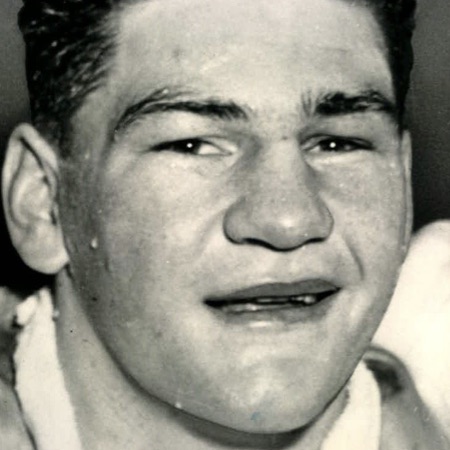
Rex Layne
Legendary Contender
Rex Layne was a leading American heavyweight contender in the early 1950s. The Utah fighter defeated Jersey Joe Walcott before Walcott became world champion and later earned a disputed decision over former champion Ezzard Charles. He never fought for the world heavyweight title, but his best results placed him among the men capable of influencing who received that opportunity.
Layne’s career intersects with the rise of Rocky Marciano and the transition from the Charles–Walcott championship rivalry to Marciano’s reign. His victories made him a serious contender; his defeats show how demanding the route to a title challenge could be when established champions and ambitious younger heavyweights competed for the same openings.
Rex Layne, the Utah heavyweight known as the Lewiston Larruper.
From Lewiston to the National Amateur Championship
Rex Gessel Layne was born on June 7, 1928, in Lewiston, Utah. Before boxing became his profession, he worked on a sugar-beet farm and served with the United States Army in Japan. Those beginnings remained part of the public identity of a fighter whose nickname, the “Lewiston Larruper,” tied him closely to his hometown.
Layne developed into a successful amateur and won the national AAU heavyweight championship in 1949. That achievement provided a meaningful foundation for his professional career: he entered the paid ranks with experience and a national result rather than simply a reputation for strength.
Managed by Marv Jensen, he made his professional debut in May 1949. The move from amateur boxing to longer professional contests required him to turn that promise into sustained performances against increasingly experienced opposition.

Beating Jersey Joe Walcott
Layne’s November 24, 1950, meeting with Jersey Joe Walcott at Madison Square Garden was a major step forward. Walcott had extensive championship-level experience and the skills to punish a less experienced opponent who approached him carelessly.
Layne won a ten-round unanimous decision. His pressure and persistence gave him a result against an opponent of much greater established stature, and the victory brought national attention to the young Utah heavyweight.
The chronology matters. Walcott was a future world champion on that night, not the reigning champion. He would win the title from Charles in July 1951. Layne’s victory was therefore a significant non-title achievement, not a championship win or a successful world-title defence.
Beating Walcott did not guarantee a title opportunity. It did establish that Layne could do more than build a record against developing opposition: he could defeat an accomplished heavyweight whose championship ambitions were still very real.
A Hard Fight with Bob Satterfield
On March 9, 1951, Layne met Bob Satterfield. Satterfield’s power made him dangerous even when a fight appeared to be moving against him, and Layne had to survive a first-round knockdown before finding a route to victory.
Layne recovered and stopped Satterfield in the eighth round. The result strengthened the case for his place among the leading contenders, while the difficult opening demonstrated the risks of his direct approach.
That combination of resilience and vulnerability became important to the way his career unfolded. Layne could remain competitive after absorbing punishment, but heavyweight power could also change a contest before his persistence had time to tell.
Rocky Marciano Ends the Momentum
On July 12, 1951, Layne faced Rocky Marciano at Madison Square Garden. Neither man was world champion. Marciano was still building the run that would eventually carry him to the title, while Layne’s victories over Walcott and Satterfield made him a substantial test.
Marciano knocked Layne out in the sixth round. The defeat interrupted Layne’s progress and supplied an important victory in Marciano’s own development. It should not be described as a world-title fight or as a championship defence by Marciano.
For Layne, the result also changed the balance of his career. Recent victories had put him near the front of the contender field; a decisive defeat showed how quickly that position could be weakened. He remained a significant opponent, but he now had to rebuild his claim.
Three Contests with Ezzard Charles
Layne’s rivalry with Ezzard Charles produced three very different results. Their first meeting took place at Pittsburgh’s Forbes Field on October 10, 1951, after Charles had lost the world title to Walcott. Charles stopped Layne in the eleventh round.
The rematch came in Ogden, Utah, on August 8, 1952. This time Layne received a ten-round decision, with former heavyweight champion Jack Dempsey serving as the sole referee and scorer. The verdict was disputed, and contemporary criticism forms part of the bout’s history.
The official result remains a Layne victory. Describing it accurately means acknowledging the controversy without turning disagreement into a claim that the result was reversed or that wrongdoing was proved. Charles was a former world champion at the time, and the contest carried no world heavyweight title.
Charles won their third meeting in San Francisco on April 1, 1953. He knocked Layne down three times and took a ten-round unanimous decision. Across the series, Charles won twice and Layne once; the sequence illustrates both Layne’s ability to compete at a high level and the difficulty of doing so consistently.
The La Starza Eliminator
Between the second and third Charles fights, Layne met Roland La Starza on February 13, 1953. Their ten-round contest was a heavyweight title eliminator, with Marciano now holding the championship.
La Starza won a split decision and subsequently challenged Marciano. Layne had reached a fight with a direct bearing on the next championship opportunity, but the result moved that opportunity towards his opponent.
His career therefore needs a distinction between being a leading contender, participating in an eliminator and actually challenging for the world title. Layne achieved the first two; he never entered a world heavyweight championship contest.
Later Fights and Retirement
Layne continued boxing after the most prominent phase of his career, but he did not recover the position created by the Walcott and Satterfield victories. He remained active through 1956, finishing with a recorded professional total of 50 wins, 17 losses and three draws, including 34 knockout victories.
The totals describe a busy career, but its historical value lies especially in the quality and timing of the opposition. Walcott, Charles and Marciano were central figures in the heavyweight championship’s passage through the early 1950s. Layne met all three while that history was unfolding.
A Contender’s Place in Heavyweight History
Layne died on June 7, 2000, his seventy-second birthday. His strongest years were brief, but they produced results that deserve more than a passing reference in the biographies of famous champions.
He was a national amateur champion who became a serious professional contender, beat a future world champion and a former one, and competed in a title eliminator. He was not a world heavyweight champion, and treating him as one would obscure the genuine accomplishments of his career.
The Lewiston Larruper’s story is about the competitive depth beneath the championship itself. His successes helped determine which heavyweights mattered in the division; his setbacks demonstrated how narrow the final route to a title opportunity could become.

