WORLD Heavyweight Boxing

Month
Date
,
Year
Legendary Contender
Carl “The Truth” Williams was a heavyweight contender whose best weapon was a long, commanding left jab. He challenged Larry Holmes for the IBF championship in 1985 and Mike Tyson for the undisputed title in 1989, but never won a world heavyweight championship. His USBA title and victories over established opposition belong to a strong contender’s career, not a world champion’s reign.
The two title attempts produced sharply different memories. Against Holmes, Williams boxed effectively over fifteen rounds and made an ageing champion work for a unanimous decision. Against Tyson, he was stopped after just ninety-three seconds. Neither result, taken alone, explains a career that also included wins over Bert Cooper and Trevor Berbick and a dangerous challenge to Tommy Morrison.
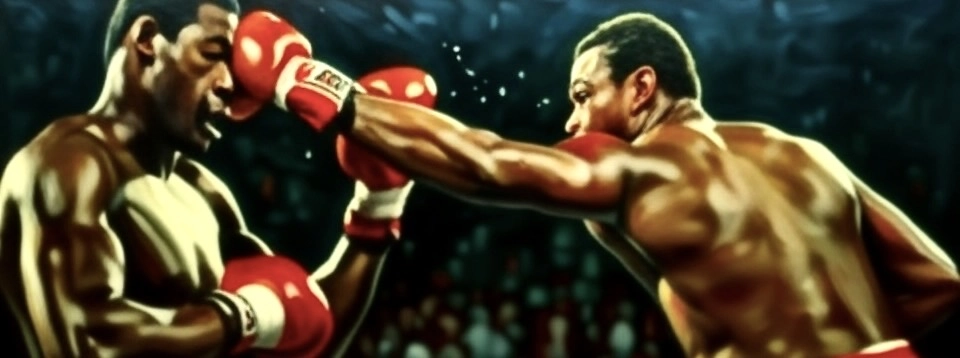
Illustration of Larry Holmes and Carl Williams from HB’s coverage of their 1985 championship contest.
Williams was born on November 11, 1959, in Belle Glade, Florida, and became associated with White Plains, New York, during his boxing career. He developed through New York’s amateur scene, winning the Golden Gloves sub-novice heavyweight championship in 1980 and the open heavyweight championship in 1981.
Those achievements came shortly before his professional debut in January 1982. Williams progressed quickly, using his height and exceptional reach to establish distance rather than relying solely on the physical strength expected of a heavyweight.
His jab was more than a scoring punch. It could stop an opponent’s approach, provide the opening for a right hand and allow him to dictate where exchanges began. At his best he looked like a natural successor to the division’s great long-range boxers. Against powerful opponents, the difficulty was maintaining that control through every phase of a fight.
Williams remained unbeaten through his early professional development. A victory over James Tillis in October 1984 helped establish him beyond the prospect stage: after being knocked down early, he recovered to win a ten-round decision.
The performance showed resilience as well as boxing ability. It also gave Williams experience against an opponent who had already operated at championship level. By the time he met Holmes the following May, he had advanced rapidly from an amateur champion to a contender with a genuine world-title opportunity.
On May 20, 1985, Williams challenged Holmes at the Lawlor Events Center in Reno, Nevada. Holmes defended the IBF heavyweight championship; this was not a vacant-title contest, and Williams did not enter as a defending champion.
Williams’s jab and movement made the contest demanding for Holmes. He could compete at the veteran’s preferred distance and sustain his work across the championship rounds. Holmes still found important openings and finished strongly enough to retain the title by unanimous decision.
One judge scored it 143–142, while the other two had Holmes ahead 146–139. Williams believed he had done enough to win, and the breadth of the wider cards attracted criticism. The official outcome remains a Holmes victory, but Williams had shown that he belonged in serious championship company.
The bout was televised by NBC and became an important part of Williams’s reputation. HB’s feature on the Holmes–Williams broadcast examines its place in the changing business of heavyweight television. For Williams himself, the sporting significance was clear: his first defeat also supplied the strongest evidence of his ability.
Williams followed the Holmes loss with a victory over Jesse Ferguson, but Mike Weaver halted his momentum in February 1986. The former WBA champion knocked him down three times in the second round, forcing a technical-knockout stoppage.
The defeat exposed the risk inherent in Williams’s style. A heavyweight who worked effectively behind a jab could still be caught when a powerful opponent crossed the distance. Weaver’s left hook had an immediate effect, and Williams could not recover as he had against Tillis.
He rebuilt rather than disappearing from contention. In June 1987, Williams defeated Bert Cooper for the vacant USBA heavyweight title. Cooper went down in the opening round and remained in his corner after seven completed rounds. The USBA belt was a regional championship, valuable to Williams’s progress but distinct from the world titles he pursued.
Williams’s June 27, 1988, victory over Trevor Berbick was another important step. They fought in Atlantic City on the undercard of Tyson’s meeting with Michael Spinks, with Williams winning a twelve-round unanimous decision.
Berbick had been WBC champion, but no world championship changed hands in this contest. Williams’s jab repeatedly found the target, and he accumulated points against an opponent who tried to make the fight more physical. The result reinforced his standing as a leading challenger rather than merely a fighter remembered for a close loss to Holmes.
On July 21, 1989, Williams challenged Tyson in Atlantic City for the unified WBA, WBC and IBF heavyweight titles. His task was to keep the champion outside with his jab and prevent Tyson from establishing the short-range combinations that had overwhelmed other challengers.
Tyson found his opening almost immediately. As Williams extended a jab, the champion slipped to his left and countered with a left hook, knocking him down. Williams got up, but referee Randy Neumann stopped the contest at 1:33 of the first round.
Williams and his corner protested, arguing that he should have been allowed to continue. Neumann maintained that the challenger’s response after rising did not demonstrate that he was ready to defend himself. The stoppage was controversial, but it was not overturned. Williams’s second world-title attempt ended in a first-round technical knockout.
The brevity of the fight became disproportionate to the rest of his career. It offered an enduring example of Tyson’s speed and counterpunching, while concealing the sustained ability Williams had shown against Holmes, Cooper and Berbick.
Williams remained active after Tyson and continued meeting substantial opposition. A split-decision loss to Tim Witherspoon in 1991 again showed how close he could come against a former world champion without securing the result.
His January 16, 1993, contest with Tommy Morrison in Reno was particularly dramatic. Williams suffered early knockdowns but dropped Morrison twice in the fifth round, creating a real opportunity to win. Morrison recovered and stopped him in the eighth.
That contest preceded Morrison’s WBO championship win over George Foreman. It was not a WBO title fight, and Williams was not challenging a reigning world champion on that night. Its importance lies instead in the danger he still posed and his ability to change the direction of a fight after an unpromising start.
Williams also faced Frank Bruno later in 1993 and continued boxing until 1997. His recorded professional career ended at 30 wins and 10 losses, with 21 knockout victories and one no contest.
After retirement, Williams worked in security, including at Ground Zero following the September 11 attacks and later for Verizon in Queens. He died of esophageal cancer on April 7, 2013, aged fifty-three.
His boxing legacy is best understood through the level of opposition he met and the skill he brought to those contests. He never held a world heavyweight title, but he earned two opportunities to fight for one, won the USBA championship and defeated men who had meaningful claims to contender status.
Williams was neither an invulnerable technician nor simply a victim of famous champions. The jab, reach and composure that troubled Holmes were genuine strengths. So were the determination he showed after early knockdowns and the ability to rebuild after damaging defeats. The Truth’s career remains a useful reminder that accomplished heavyweight challengers deserve a history of their own.

Top Heavyweight Boxing covers the past, present and future of boxing's premier division. Copyright© 2026
Powered by Digital Dynasty Design