Gerry Cooney brought one of the most dangerous left hooks of his generation to the heavyweight division. His victories over Jimmy Young, Ron Lyle and Ken Norton made him a major attraction, and his 1982 challenge to Larry Holmes became an event whose promotion threatened to overwhelm the boxing. Cooney never won the world title, but reducing him to a failed challenger misses both the force of his early performances and the courage he showed against a great champion.
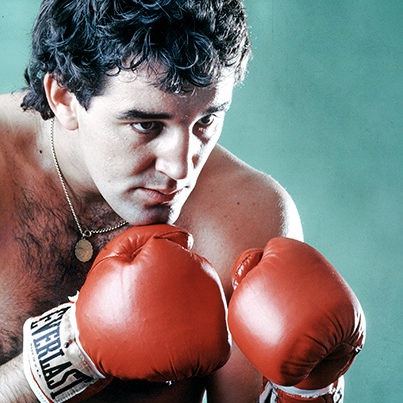
Gerry Cooney posing with red boxing gloves. His left hook made him one of the division’s most feared contenders.
From Long Island to the professional ring
Cooney grew up in Huntington on Long Island and developed through amateur boxing before turning professional in 1977. He was an unusually tall heavyweight, but he did not fight as a man content to keep opponents at the end of a long jab. His most effective work came when he could step into punching range and drive his left hand into the body or head.
That approach gave him an immediately recognisable identity. A single clean hook could change a contest, while sustained attacks could force an opponent to retreat without finding a safe place to regroup. Cooney’s size helped him generate leverage, but his appeal came from what he did with it: he looked for a finish rather than merely a points advantage.
Young, Lyle and Norton establish his threat
In 1980, Cooney stopped Jimmy Young on cuts after four rounds and knocked out Ron Lyle in the first. These were experienced heavyweights with substantial careers behind them. They were also past their best, a distinction that matters when assessing what the victories demonstrated.
The result against Ken Norton at Madison Square Garden on May 11, 1981, was even more dramatic. Cooney overwhelmed the former WBC champion in 54 seconds. Norton could not withstand the opening assault, and the speed of the stoppage turned Cooney into an obvious commercial challenger for Holmes.
Those victories established genuine punching danger. They did not establish how Cooney would cope with a champion who could jab, move, recover and maintain a tactical plan deep into a long fight. Quick finishes brought recognition while leaving important questions unanswered.
A title promotion burdened by race
Cooney entered the Holmes fight unbeaten at 25-0. The contest took place at Caesars Palace in Las Vegas on June 11, 1982, with Holmes defending the WBC heavyweight championship. The champion had already proved himself through years of title defences; Cooney arrived with explosive results and enormous public interest.
The promotion repeatedly framed the matchup through race, casting the white challenger against the Black champion. That framing was unfair to Holmes and placed an additional burden on Cooney. It also distorted the sporting question. The fight was a test of two heavyweights, not a legitimate measure of the communities to which they belonged.
The atmosphere should be remembered because it shaped the event. It should not be allowed to replace an assessment of the boxing, or be treated as proof of personal hostility between the fighters. Holmes and Cooney later developed a friendship.
Thirteen rounds against Larry Holmes
Holmes knocked Cooney down in the second round, but the challenger recovered and remained competitive. His body punching gave the champion something serious to manage. Cooney was not simply overwhelmed at the first sign of resistance: he continued pressing and found opportunities to land his most dangerous weapon.
Holmes nevertheless had the broader range of answers. His jab and right hand controlled exchanges, and his championship experience helped him navigate Cooney’s strongest phases. Cooney also lost three points for low blows, an important part of the official contest rather than a detail to omit from a sympathetic account.
In the thirteenth round, Holmes’ attack brought the fight to an end. Cooney’s corner intervened as the exhausted challenger took further punishment. It was a technical-knockout defeat, but it also showed a willingness to compete that his brief earlier victories had never required him to demonstrate.
Inactivity and the Michael Spinks challenge
Cooney fought only three times between the Holmes defeat and his June 15, 1987, meeting with Michael Spinks in Atlantic City. Those wins maintained his name and record, but they did not provide a sustained rebuilding programme against leading opposition.
Spinks had beaten Holmes twice and retained the lineal championship claim, although the IBF had stripped him of its belt. No sanctioning-body title was at stake against Cooney. Describing the contest simply as an ordinary world-title defence would therefore conceal an important distinction.
The smaller Spinks used movement, timing and combinations to prevent Cooney from imposing his power. He stopped him in the fifth round. The outcome illustrated the difference between possessing a dangerous punch and consistently creating opportunities to land it against an elite opponent.
George Foreman and the final professional fight
Cooney returned once more to face George Foreman in Atlantic City on January 15, 1990. Foreman was rebuilding his own career, but his comeback had been much more active. He knocked Cooney out in the second round.
It was Cooney’s final professional appearance. He finished with a record of 28-3, including 24 knockout victories. All three defeats came against men who had held the heavyweight championship: Holmes, Spinks and Foreman. That fact identifies the quality of the opponents who beat him without erasing the limits of his own championship credentials.
Recovery and a life beyond the knockout
Cooney has spoken openly about an abusive childhood and his recovery from alcoholism. His later story also includes work helping retired fighters through the Fighters’ Initiative for Support and Training. Those experiences give his career a human dimension that a list of results cannot convey.
His place in heavyweight history rests on a powerful but incomplete promise. He could devastate experienced opponents, trouble a great champion and attract an extraordinary audience. He could not turn those qualities into a title reign. Remembering both sides produces a fairer portrait than either the promotional legend or the easy dismissal of a man who fell short.
Documentary: an overview of Cooney’s heavyweight career.